
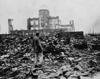
In his radio address to the nation today, President Bush boasts about the strong US economy and the tens of thousands of McJobs that have been created over the last month. There was no mention of the Iraq War, which is going badly and inflicting a terrible toll on American troops. Nor was there any mention of the meaning of August 6: sixty years ago today the United States dropped an atomic bomb on Hiroshima, instantly killing at least 70,000 with as many as 50,000 more dead within the weeks and months that followed. Three days later another atomic bomb was dropped slightly off target on Nagasaki, killing another 40,000 citizens and dooming tens of thousands.
Americans don’t think much about this event, and when they do they tend to think in cliches that have been fed to them over the years. The typical response is that dropping the atomic bomb on the Japanese civilian population saved hundreds of thousands, if not millions of lives – both Japanese and American:
Florida dentist Robert Gleiber, an amateur World War II historian and collector of Enola Gay memorabilia, said Japan’s civilian losses were regrettable but had to be weighed against the alternative of a bloody invasion of that country.
"Truman was responsible for saving hundreds of thousands or even millions of lives both Japanese and American," he said. "The Japanese were fanatics and they were going to fight to the last man."

The German author Peter Bürger has a new book coming out this month: Hiroshima, der Krieg und die Christen, which examines the Christian response to the bombings of Hiroshima and Nagasaki. In advance of the publication, Bürger has several important articles on Telepolis. His first article, Civilization has learned nothing from Hiroshima struck a chord with me as I watch the response to the event today in the US. America, Bürger says, suffers from a "willful amnesia" (Verdrängung ) concerning what it did in Hiroshima. and until it is able to face the truth and process history the future of the planet is at risk.
Die Errungenschaften der Kriegstechnologie preist man ausdrücklich als jene Instrumente an, die die Menschheit zur Abwehr globaler Katastrophen benötigt. Die zentralen Überlebensfragen der Zivilisation werden weithin auf dem Niveau der Coca-Cola-Werbung abgehandelt oder durch irrationale Mythen verschleiert.
Bürger quotes Adorno (Minima Moralia): Es gehört zum Mechanismus der Herrschaft, die Erkenntnis des Leidens, das sie produziert, zu verbieten (A key aspect of the mechanism of domination is banning any knowledge of suffering that it produces.) Here one thinks of the Pentagon’s policy of banning photos of coffins returning from Iraq. With respect to Hiroshima and Nagasaki, the US government was successful in suppressing the graphic film images that were taken by American and Japanese photojournalists and filmmakers in the days immediately following the bombings. You can read the story of this amazing cover-up here.
Chris Hedges has a chapter on "The Hijacking and Recovery of Memory" in his book on war: War is a Force That Gives Us Meaning.
Historical memory is hijacked by those who carry out war. They seek, when the memory challenges the myth, to oblitereate or hide the evidence that exposes the myth as lie. The destruction is pervasive, aided by an establishment, including the media, which apes the slogans and euphemisms parroted by the powerful. Because nearly everyone in wartime is complicit, it is difficult for societies to confront their own culpability and the lie that led to it.
Will America ever recover its memory?

0 comment
Thanks for this very interesting and ressourceful post.
ForThanks for this very interesting and resourceful post.
Choosing to forget atrocities seems to be quite common. Japan still does not accept full responsibility for atrocities in China (check out “Rape of Nanjing” by Iris Chang), South Korea, Indonesia. Yes, politicians have apologized, but they still visit the Yasukuni shrine and try to change history by changing textbooks.
A Poli Sci prof argued in Die Sueddeutsche yesterday that Japan used the bombing of Hiroshima to characterise itself as victims rather than perpetrators of WW2.
Das ”Geschenk des Himmels” – sueddeutsche.de – Feuilleton
Wie Japan die Katastrophe nutzte, um die eigene Schuld vergessen zu machen und sich zur Opfernation zu stilisieren / Von Peter Reichel
http://www.sueddeutsche.de/sz/2005-08-05/feuilleton/artikel/HMG-2005-08-05-013-yMGEvrvMj0GjdJImESlQnQ/
Unfortunately, one has to pay for getting online access
Thanks for the reference. There is another article about this on DerSpiegel Web site:
http://www.spiegel.de/panorama/0,1518,367258,00.html
Denn Japan betrachtet den Zweiten Weltkrieg durch den Filter des 6. August 1945. “Der Abwurf der Atombombe gab dem Land Gelegenheit, sich als Opfer darzustellen”, bestätigt der Berliner Japanologe Gerhard Krebs. “Aber Japan begann den Krieg, war also Angreifer. Das wird heute gern vergessen.”