
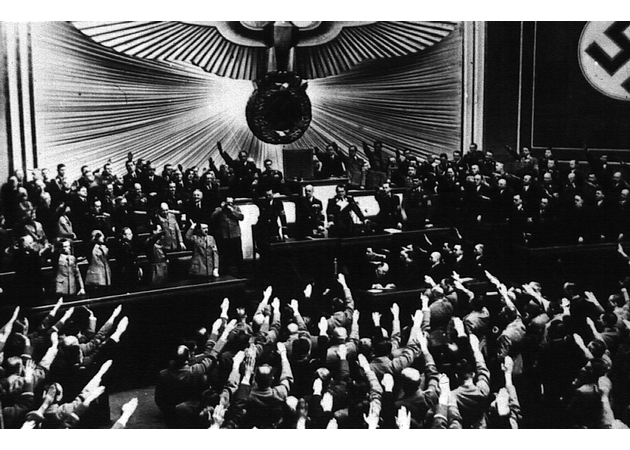
The rise of the Tea Party in the US and the debate on "integration" in Germany sparked by Thilo Sarrazin's book have exposed a disturbing authoritarian current in both countries. Right-wing extremist views which only a few years ago would have been marginalized are now finding expression among mainstream political leaders and the media. There is a deep dissatisfaction with the national political parties and yet a sense that "the people" – das Volk – demand change and must pursue it at all costs. The völkisch-national weekly Junge Freiheit writes this week:
Zwischen der Allmacht der Linken und der Feigheit
der Bürgerlichen gibt es also einen dialektischen Zusammenhang. Doch es
gibt Ansätze für konservatives Rebellentum… Die Wut der Bürger ist
groß. Eine konservative Renaissance liegt in der Luft.(There is a dialectical connection between the omnipotence of the Left and the cowardice of the national parties. But there are signs of a conservative rebellion…the outrage of the citizens is great. A conservative renaissance in the air.)
The Web site German-Foreign-Policy.com has an interesting analysis of Sarrazin's popularity in Germany and how populist anger against Muslims and the "takeover by foreigners" (Überfremdung) could result in anti-democratic or extra-parliamentary political developments:
Die hysterisch geführte Debatte lässt unterschiedliche strategische
Ansätze im deutschen Establishment erkennen, das angesichts der
krisenhaften Wirtschaftsentwicklung mit weiteren gesellschaftlichen
Auflösungserscheinungen rechnet und über die Grenzen demokratischer
Herrschaftsausübung nachdenkt. Sollten veränderte Methoden notwendig
werden, spielen Islamophobie, Antisemitismus und Rassismen jeder Art
die völkische Begleitmusik, die autoritären Regimen gemäß ist. Jedoch
ist unklar, wie politische Alternativen in Funktion gebracht werden
können. So hieß es unlängst in der Zeitschrift Internationale Politik:
"Wenn heute verschiedentlich von diktatorischen Befugnissen und
Maßnahmen die Rede ist, dann zumeist im Sinne dessen, was (der
NS-Ideologe Carl, d.Red.) Schmitt als kommissarische Diktatur
bezeichnet hat", also als zeitweilige Diktatur. "Es gibt bloß", hieß es
weiter, "kein Verfassungsorgan, das sich auf das Risiko der Einsetzung
eines kommissarischen Diktators einlassen will"
(german-foreign-policy.com berichtete [12]). Auch von dieser
Auseinandersetzung sind Tabus der bundesdeutschen Nachkriegsordnung
betroffen, für deren Bruch eine Fraktion der deutschen Machteliten
offen ist.(One can detect different strategic approaches by the German establishment from the hysterical debate (Sarrazin) which, in view of the economic crisis, is counting on further social collapse and is considering the limits of the democratic exercise of power. Should new methods become necessary then Islamophobia, anti-Semitism and racism provide a background that is conducive to authoritarian regimes. But it is still unclear how political alternatives can be put into practice. Thus the Journal of International Policy recently wrote: "Today when dictatorial powers and measures are discussed, then it is usually in the context of a "provisional dictatorship" (as defined by the Nazi jurist Carl Schmitt)." In other words, a temporary dictatorship. "However, there is no constitutional body that would take the risk of implementing a provisional dictatorship." Today a portion of the German power elite is open to breaking with these taboos of Germany's postwar order.)
The US is much further along the curve than Germany, thanks primarily to the repeated violations of constitutional law by the Bush administration, which "normalized" extraordinary rendition and legitimized torture as patriotic. Now the inchoate rage of the Tea Party is further threatening constitutional law (namely the First and Fourteenth Amendments). Political leaders and respected pundits are demanding that Muslims be denied First Amendment protection and Muslim lives should not be valued as highly as non-Muslim.
Erich Fromm, the brilliant psychoanalyst and social thinker, described a core aspect of the authoritarian mindset in his classic study Escape from Freedom (1941):
In authoritarian philosophy the concept of equality does not exist. The authoritarian character may somtimes use the word equality either conventionally or because it suits his purposes. But it has no real meaning or weight for him, since it concerns something outside the reach of his emotional experience. For him the world is composed of people with power and those without it, of superior ones and inferior ones. On the basis of his sado-masochistic strivings, he experiences only domination or submission, but never solidarity. Differences, whether of sex or race, to him are necessarily signs of superiority or inferiority. A difference which does not have this connotation is unthinkable to him.

0 comment
I believe there is a dualism between a democratic and dictatoric approach:
Whenever times are good and the economy prospers, the people demand their share in the newly gained wealth and thus want political representation.
However when times are tough and the people feel threatened economically or for other reasons, they realize that tough decisions cannot be made when everybody is allowed to have a say in the matter. Thus a charismatic and promising figure finds many followers and can acquire leadership over the entire country.
One should not condemn either of those approaches in my humble opinion. Both have their times and none will last forever.
Good point, Zyme. My concern is that in this time of economic crisis people are inclined to demonize a particular ethnic or minority group.
Also, I hope that a “charismatic and promising figure” does not emerge and the movement will just disappear.
If you had wished for something differently, I would have been shocked 🙂
Then I am right to assume that you would consider the democratic approach to always be the right one, regardless of the circumstances?
But doesn’t this also mean that you neglect the differences in mentalities across the world? There are individualistic and authoritarian peoples, aren’t there?
I surely agree that in the anglo-saxon part of the world the individual’s point of view is crucial.
However, in nations where the majority’s will is of primary importance, the fate of minorities plays too little a role to prevent scapegoating.
As regards charismatic leaders: I think in nations with millions of people there is a certain chance of such a figure emerging with every year of a real or perceived crisis passing.
I think of it like playing roulette: Even if you keep betting on a single number only, over and over, it is only a matter of time until you hit it.
// Thus the Journal of International Policy recently wrote: “Today when dictatorial powers and measures are discussed, then it is usually in the context of a “provisional dictatorship” (as defined by the Nazi jurist Carl Schmitt).” //
Thanks for the link to german-foreign-policy.com . I’ve just been reading articles detailing Germany’s determination to elbow its way to Arctic resources.
I note an elaborated form of your above quote, in English, here —
A Bit of Dictatorship 2010/06/15
http://www.german-foreign-policy.com/en/fulltext/56352