
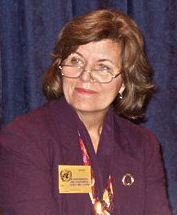
The Boston Globe published the obituary today of Randall Caroline Forsberg. She was 64 years old and at the time of her death on Friday was the executive director of the Institute for Defense & Disarmament Studies, a Cambridge-based think tank.
So far, the news of her death has received no notice in the international press, yet she launched a movement that had a profound impact on international relations in the 1980s. As a graduate student at MIT in 1980, Randall Forsberg started the Nuclear Weapons Freeze Campaign at a time when the Reagan administration was threatening nuclear war with the Soviet Union. The grass roots movement quickly caught the imagination of the American people:
"The Freeze campaign made remarkable progress. Holding its first national conference in March 1981, the Freeze began organizing all across the country. On June 12, 1982, when peace groups sponsored an antinuclear demonstration in New York City around the theme of “Freeze the Arms Race—Fund Human Needs,” it escalated into the biggest U.S. political demonstration thus far, with nearly a million participants. That fall, Freeze referenda appeared on the ballot across the nation. In this largest referendum on a single issue in U.S. history (covering about a third of the electorate), the Freeze emerged victorious in nine out of ten states and in all but three localities. Five different polls taken during 1983 found average support for the Freeze at 72% and opposition at 20%. Hundreds of national organizations endorsed the Freeze, as did more than 370 city councils and one or both houses of 23 state legislatures.This popular uprising had a major impact upon government officials. Horrified by the Freeze campaign, the Reaganites did their best to discredit and destroy it."
Soon Randy Forsberg’s work caught the attention ot the new Party Secretary in Moscow:
The Freeze also hit paydirt in the Soviet Union. Taking office as Soviet party secretary in March 1985, Gorbachev was profoundly influenced by the worldwide antinuclear campaign. His "new thinking" about war and peace, Gorbachev declared, "absorbed the . . . demands . . . of . . . antiwar organizations." At international disarmament conferences, he set aside time to confer with leaders of SANE and the Freeze.
The success of the Nuclear Freeze movement led President Reagan to change course dramatically with respect to the nuclear arms race. For the first time since the beginning of the Cold War the US and the Soviet Union agreed to reduce their nuclear arsenals. For an excellent history of this period and an account of Randall Forsberg’s work, I recommend James Carroll’s book House of War.
The real accomplishments of the Nuclear Freeze movement in the 1980s during the Reagan administraion were later reversed by President Clinton. And under President George W. Bush military action and the threat of military action have become the dominant instruments of American foreign policy. The activities of Dr. Forsberg and people like her are ridiculed. We are closer now to a nuclear conflict – this time with Iran – than we have been for nearly two decades. We will miss Randall Forsberg’s quiet voice of reason. Her message lives on, and the planet cannot afford not to heed it.
"There is only one circumstance that justifies the use of force: If someone is attacking you, you have a moral obligation to defend yourself. Applying that rule would lead to a surprising conclusion. If all countries upheld the ethic that the only just war – the only legally, morally acceptable use of force – was for defence, then there would be no war. We wouldn’t need military defence. People would use non-violent means of correcting injustices – with protest, with civilian resistance. Paradoxically, if you use armed force only to defend yourself, and if you believe this, what you end up with is a world in which you don’t need it." -Randall Forsberg
