
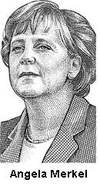
So how has Angela Merkel fared in her first 12 months as Germany’s chancellor? In principle, the German voters should be pleased: Germany enjoys a new prestige internationally, relationships with Washington are greatly improved, and the long-moribund Germany economy is enjoying an upswing. Even the intractable unemployment picture looks brighter: nearly half a million new jobs have been created. So why do only 30% of Germans polled approve of her performance and that of her party, the Christian Democrats (CDU) – the lowest approval ratings in more than six years?
Part of the problem lies in the high expectations of a year ago. Angela Merkel was supposed to bring a new, no-nonsense style to the chancellory – a big contrast to the Clintonesque style of her predecessor. Angela Merkel would be cool, decisive, bringing to bear a scientific management style as befits a physicisit. She had the right leadership style to push through the political and economic reforms that were desperately needed. But this has been the biggest disappointment: she has shown herself to be an overly cautious, hesitant leader at home, as Heide Simonis points out in the FT Deutschland:
Diese Angela Merkel ist anders. Sie ist nicht die zupackende, mutige Frau, die vor herben politischen Operationen nicht zurückschreckt, die durchregiert. Sondern sie zaudert, zögert, wägt lange ab und entscheidet dann doch nur halbherzig oder gar nicht. Das Ganze wird dann als der besondere Politikstil einer Naturwissenschaftlerin dargestellt.
Simonis says that Merkel cannot claim any credit for the brightening employment picture in Germany. If anything, some credit should be given to Gerhard Schröder for his unpopular reforms which ulitmately cost him the election. Business leaders are disillusioned with Merkel, big companies like VW and Deutsche Telekom continue to lay off thousands of workers. But the Workers Councils (Betriebsräte)of the privately-owned, medium-sized business (Mittelstand) have acted pragmatically and have kept wages and operating costs down: it is the Mittelstand which is creating the bulk of the new jobs.
Not everyone is so pessimistic about Merkels prospects for the next 12 months. Reuters has this upbeat assessment:
Forging a compromise on loosening labour market regulations, mapping out a long-term energy strategy and pushing through a privatisation of railway operator Deutsche Bahn could help Merkel win back the disillusioned German business community.
The EU and G8 presidencies are rife with challenges — from reviving Europe’s stalled constitution to handling a looming crisis on Turkey’s faltering EU bid. But they could also play to Merkel’s strengths as a mediator.
"I think she can recover," said Gerd Langguth, a professor at Bonn University and Merkel biographer. "The EU and G8 will help shift attention from her domestic problems, but she must make sure she doesn’t take her eye off the ball at home."
