
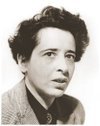
The Hannah Arendt centennial is now in full swing; a comprehensive listing of conferences and other events can be found here. Recently I wrote about how Hannah Arendt’s influence in American political thought would only increase while that of her fellow Weimar exile Leo Strauss would flame out along with the reputation of the neocons. That view is shared by the author Elisabeth Young-Bruehl, whose new book – Why Arendt Matters – will be released tomorrow on the 100th anniversary of her birth.
Today Arendt’s ideas seem as fresh – and as relevant – as ever, even though the threats to human civilization are radically different from those she confronted. Hans-Martin Schönherr-Mann has a nice piece today in Freitag that looks at some of Hannah Arendt’s key ideas. Schönherr-Mann ends his essay with some comments on Arendts last, incomplete, work – The Life of the Mind (Vom Leben des Geistes ) – where she comes full circle in her thinking from Hegel and Marx back to Kant.
Zur Verständnisförderung greift Arendt auf Immanuel Kants Idee einer "erweiterten Denkungsart" zurück. Wenn man den anderen Menschen verstehen will, dann muss man zunächst über seinen eigenen Schatten springen, genauer von sich selbst, seinen eigenen Prinzipien absehen. Man muss schließlich seinen Horizont erweitern, indem man sich in die Lage eines anderen Menschen hineinversetzt, nicht um ihn leichter hinters Licht zu führen, sondern um seine Urteile und Einschätzungen nachzuvollziehen. Wenn man unter den Bedingungen der Globalisierung in einer pluralistischen Welt der vielen Weltanschauungen lebt, wenn die Menschen also keine gemeinsamen obersten Werte mehr verbinden, dann braucht man vor allem derartige Kompetenzen oder Tugenden: Denkvermögen, Urteilskraft, Wahrhaftigkeit. Dazu reichen ethische Normen alleine nicht aus. Das erkannt und durchdacht zu haben, darin liegt die aktuellste Seite der Philosophie von Hannah Arendt.
Competencies for the globalized world, as defined by Arendt before the age of globalization: intellectual power, capacity for judgement, truthfulness (Denkvermögen, Urteilskraft, Wahrhaftigkeit). Looking around, these competencies would appear to be in short supply today.

0 comment
Well careful with all-out praise. One side of Arendt is also the typical jewish supremacist, bronze-age ideology on display: http://www.jungewelt.de/2006/10-13/001.php
I Remember the Final Solution-
I remember the brutal guards and sadistic tortures of women, children and the old with no food except for contaminated pieces of beef. I remember the lack of blankets with no shoes and the crying of the old, the children. There were no Nazi guards or swastika flying over the concentration camps it was the American flag and American soldiers.
The evidence was introduced at the world tribunal Court at Nuremburg by the brilliant German defense, exposing the hipocrisy of the members of the tribunal especially the representatives of the United States, concerning war crimes against the Native American people. Another words, the final solution originated in the United States not the German fatherland.
I remember as a child being moved by the German defense in the movie ‘Trial at Nuremburg” in fact, I recall my grand parents crying as the German defense addressed the hidden agenda of the United states extermination policies. Years later as an adult I saw the movie again but this time the part was missing concerning the Native Americans, obviously it has been censored. What is more interesting is that this issue is never introduced in American class rooms for discussion but either ignored or censored unlike the holocaust in Europe.
Yes, I remember the inhumanity that occured in America and can appreciate the hurt of the masses that suffered injustices abroad, but let us not point the finger at the German nation before we examined all the evidence.
In the final analysis, we must understand and appreciate that Native American people were not foreigners in another country involved in domestic politics of any sort; they are merely victims of geo-historical politics.