
Among the most egregious lies told by the Bush adminstration in the run-up to the Iraq invasion was that war would be "self-funded" – i.e. Iraqi oil revenues would cover the costs incurred to invade.
Paul Wolfowitz in 2003:"“There’s a lot of money to pay for this that doesn’t have to be U.S. taxpayer money, and it starts with the assets of the Iraqi people…and on a rough recollection, the oil revenues of Iraq could bring between $50 and $100 billion over th the next two years…we’re dealing with a country that can really finance its own reconstruction, and relatively soon.”
Donald Rumsfeld in 2003: “Well, the Office of Management and Budget, has come up come up with a number that’s something under $50 billion for the cost. How much of that would be the U.S.burden, and how much would be other countries, is an open question.”
The White House economics advisor Lawrence Lindsay was dismissed for trying to give an honest prediction of the cost: $200 billion, which was wildly off the mark.
Harvard Magazine this month has a profile of Linda Bilmes, a lecturer at the Kennedy School of Government, who, along with Nobel laureate Joseph Stiglitz, researched and published an analysis of the true economic costs of the Iraq war. The actual costs of Bush’s war will be in excess of $2 trillion. Bilmes describes some of her methodology:
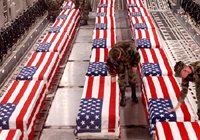
The true costs of war include items rarely mentioned before the bullets and missiles fly. The CBO figures, for example, include the costs of munitions and of transporting troops to Iraq, feeding and clothing them, and paying private contractors. But there are also the costs of caring for more than 17,000 wounded soldiers (to date)—25 percent of whom have crippling conditions such as brain injuries and multiple amputations and will need lifelong medical attention. Another 25 percent have suffered major injuries, including severe burns, deafness, and total or partial blindness. Then there are the medical expenditures for all veterans, borne by the Veterans Administration: one-third of those back from Iraq, for example, have required some mental-health counseling.
There are also disability payments. In the first Gulf War, 550,000 soldiers fought and 400 were wounded in a conflict that lasted only one month. Even so, 169,000 of those veterans, or about 30 percent, are still claiming veterans’ disability for various ailments, costing $2 billion annually. The researchers used an “extremely conservative” disability estimate of one-third of veterans to calculate their Iraq projections, though, as Bilmes notes, “it could become two-thirds or even all veterans. And all of these costs are there even if we pull out tomorrow. We haven’t paid it yet, but we already owe it.”
Of course, there is no price tag for the emotional costs of this war on the thousands of families across America that have been ruined by the deaths and permanent injuries to their sons and daughters.
