
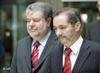
After only five months in office, Matthias Platzeck has resigned his post as head of the SPD.
April 10 (Bloomberg) — Matthias Platzeck, head of Germany’s Social Democratic Party, said he will stand down as leader of Chancellor Angela Merkel’s coalition partner for health reasons, to be replaced by Kurt Beck, the prime minister of the western state of Rhineland-Palatinate.
Platzeck, 52, who is to remain prime minister of the eastern state of Brandenburg, was admitted to hospital on March 29 and spent a week undergoing treatment after suffering hearing loss. He told reporters today he had suffered two separate episodes of hearing loss in recent months as well as a “circulatory and nervous breakdown” in February.
This leaves the party in disarray, as it struggles to carve out a distinct identity within the Red-Black Grand Coaltion. Platzeck’s replacement is the popular Kurt Beck who is the state premier of Rhineland-Palatinate. Beck has a strong trade-union background and should appeal to the SPD base. But Platzeck’s advantage was that he came from the East, where the SPD desperately needs to find votes. Whether Beck can succeed there is questionable. Franz Walter had a long piece in the Tageszeitung where he chronicles the long, slow demise of the SPD in the eastern states – which historically were a stronghold for the old Social Democratic Party. The old SPD lost its identity when it was forced to merge with the KPD to form the SED unity party in the GDR. After the reunification, those who might have been attracted to the SPD were pushed aside:
Dabei tendierten durchaus viele der Enkel und Urenkel aus früheren sozialdemokratischen Familien nach der Implosion der DDR zu einer Rückkehr in die alte SPD. Die meisten aus diesem Personenkreis verfügten über das, was schon die Sozialdemokratie vor 1933 ausgezeichnet hatte: organisatorische Fähigkeiten, Einsatzfreude, Belastbarkeit, Disziplin, Vernetzungskompetenz in Vereinen und Verbänden. Doch die Neugründer der Sozialdemokratie im Osten, bürgerliche Individualisten aus dem protestantischen Bereich, wollten mit den Sozialdemokraten aus der SED nichts zu schaffen haben – und trieben sie so in die PDS. Nicht zuletzt deshalb ist diese heute in den früheren Stammregionen der SPD so stark; deswegen liegt sie in Thüringen, Sachsen und Sachsen-Anhalt vor den Sozialdemokraten. Ein rationales, emotionsloses Urteil zur Partei und Politik links von ihr fiel der Sozialdemokratie seit je erkennbar schwer. Entweder sie idealisierte die Gemeinsamkeiten oder sie übertrieb die Gegensätze. Am Ende aber waren die Sozialdemokraten stets selbst das Opfer von Einheitsillusionen hier und Abgrenzungsdämonien dort. Zu schlechter Letzt wurden so aus sozialdemokratischen Hochburgen in den Pionierregionen der deutschen Industrialisierung Diasporagebiete für die SPD.
Whether a traditionalist trade unionist from the west can draw eastern voters away from the PDS remains to be seen.
