
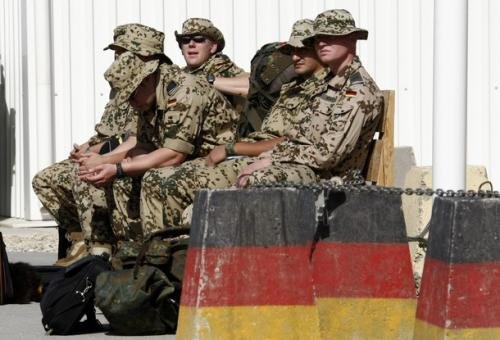
The huge NATO airstrike on Friday near the city of Kunduz in northern Afghanistan may prove to be a tipping point with respect to German support for the war effort. The strike, which killed more than 125 Afghans – including many civilians – was called in not by Americans but by Germans. So the strike
may intensify the debate in Germany, where the war in Afghanistan is
unpopular. A Forsa poll conducted for Stern Magazin prior to the airstrike found that 61% of Germans want the involvement of the Bundeswehr to end now, while only 33% supported the mission.
What impact will this latest tragedy have on the September 27 elections? The CDU has been polling far ahead of its rivals, and Angela Merkel is expected to cruise to another term as chancellor. Yet the party suffered huge setbacks last week in the regional elections in Thuringia and Saar Land. Merkel has had difficulty in articulating what Germany's interests are in the conflict but she supports an open-ended engagement. There is even speculation that she would support increasing German troop levels in Afghanistan after the elections.
The SPD has tried to seize on this percieved weakness by Merkel and the CDU by calling for a timetable demonstrating a definite date for the withdrawal of German troops. But the SPD has a major credibility problem with the voters, since the party has been the junior coalition in the government that presided over the troop buildup in the region over the past four years. The SPD has to be seen also as a loser in the recent regional elections, and at 22% the party's poll numbers are at a historic low.
Neither the Green Party nor the liberal Free Democrats appear to have a coherent message with respect to German military engagement in Afghanistan. In their Election Program (pdf) the Greens seem to support a build-up of armed "nation-building" forces for construction projects and other humanitarian initiatives. The FDP is far more focused on implementing free market "reforms" domestically, but the party leader Guido Westerwelle has made comments supporting German troop deployments to protect Germany from "terrorists".
Only DIe Linke – the Left Party – has come out officially for an immediate withdrawal of German troops from Afghanistan. And the message appears to be resonating with voters:
Left”), formed in 2007 in a merger of disillusioned SPD members,
unionists, socialists and members of the Party for Democratic Socialism
— the reformed successor to the former ruling party of East Germany.
In the former East German state of Thuringia, Die Linke reached
second place with 27.6%, nine percent ahead of the SPD and just behind
the CDU’s 31.3%. In Saxony, Die Linke achieved 20.6% — twice the SPD
vote.
If the SPD and the Greens were willing to join with DIe Linke in a Red-Red-Green coalition, there might be a chance that Germany could disengage from the quagmire in Afghanistan. That possibility, has been ruled out by the SPD, who seem more energized in demonizing Oskar Lafontaine – the leader of Die Linke – than in attacking the policies of the CDU.
