
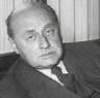
Gottfried Benn died fifty years ago this month, and to mark the occasion I have been working my way through his Sämtliche Gedichte. Benn has always been a fascinating poet to me; I am at once dazzled by the brilliance of his lyric poetry and at the same time repelled by his dark vision. A physician, Benn put his intimate knowledge of the human anatomy to effective use in his early expressionist poems. There is not much Benn available in English translation, but English readers can download some excellent translations of these early poems (translated by Michael Hamburger) here. Unlike his nemesis Brecht (who also died in Berlin 50 years ago this summer), Benn was a reserved introvert who longed for – and at the same time wanted to break free from – isolation. I think that was what initially attracted him to National Socialism (he was an enthusiastic supporter in the early days of the Third Reich): Benn saw the vitality and dynamism of the Volksgemeinschaft as a way out of his isolation. But to his dismay his own works were condemned by the Nazis as entartet (degenerate). To his credit, Benn never glossed over his flirtation with fascism and confronted it head-on, with a clear eye, in his autobiographical work Doppelleben (1950).
New insight into Benn’s Double Life can be found in a new exhibit at the Deutsches Litaturarchiv Marbach. The archive is presenting for the first time the correspondence that Benn had with a former lover, Gertrud Zenzes, which lasted nearly thirty years, from his expressionist days, to his brief association with the Nazis, through his "inner emigration", and finally the postwar years when Benn achieved some measure of recognition as a modernist poet. Most of the letters were sent to America, where Zenzes, a researcher and literary scholar, had emigrated already in 1926. Zenzes was a remarkable woman and Benn had absolute trust in her. Die Zeit has published three of the letters online, including a fascinating letter to Gertrud in San Francisco in September 1933, where Benn makes an attempt to justify his enthusiasm for the New Order in Germany, and where he notes that Gertrud’s adopted homeland is especially hostile to the new German government:
[my translation] Perhaps, dear Trudy, you would be interested in hearing from me personally about what I wrote in my book (Der neue Staat und die Intellektuellen), namely that I, along with the majority of Germans, endorse the new state, consider Hitler a great statesman, and above all am absolutely convinced there was no other possiblity for Germany. And it’s just the beginning; the other countries will follow: a new world is beginning; the world that you and I grew up in is played out and is finished. You must not get too agitated in thinking about this. You must wrap your mind around the fact that we are witnessing a turning point in western civilization, that can only be compared to happend in the 11th century, or at the end of antiquity. Those who object need to ask themselves: are they thinking historically, or are they thinking privately? If one thinks only privately, then he can criticize, and utter the usual intellectual nonsense. But those who think historically will remain silent, and accept all of the inner destruction and even personal pain that this new age might bring, for he knows that behind these changes are the laws of life that have nothing to do with personal happiness, but rather destiny. I can well imagine that people living in other countries might find all of this highly unrealistic and exaggerated. But it is what we have experienced in Germany – it is the German Experience: the dissolution of the individual in favor of the Volk, the Race, the distant mythical Collective, which now finally represents humanity.
So Benn was initially deluded into thinking that submitting to the Volk could release him from his oppressive loneliness. He soon realized, however, that he was more marginalized than ever. But he came to embrace his loneliness, his isolation, and it became his muse. In his poem Reisen (Travels) he talks about the folly of trying to escape oneself by traveling to Zurich or Fifth Avenue (he never did travel to America to see Gertrud Zenzes):
ach, vergeblich das Fahren!Spät erst erfahren Sie sich:bleiben und stille bewahrendas sich umgrenzende Ich.
