
It has been one week since the general election in Germany. Is the outcome any clearer today? Today’s Boston Globe reports on the frustration among the voters:
A week after an inconclusive election, Germans seem uncertain whether they are caught in a national crisis or an epic farce. Some are deeply fearful, some are mildly fretful, while many just shrug off the extraordinary situation as bad political comedy.
Some things we do know today:
-
Jamaica has receded back into the deep blue Caribbean.
-
The Left Party is still persona non grata.
-
Schröder regrets his boorish behavior following the election.
-
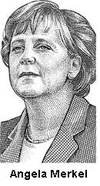
Angie is "bloodied and wobbly but unbowed" (NYTimes).
So a chastened Schröder floats the "Israel Option" – a grand coalition with the CDU with a job-sharing chancellorship:
The head of an influential SPD group said the party’s parliamentary deputies favoured a power-sharing plan with the Christian Democrats (CDU) that would let Schroeder hold office for two years before handing over to the CDU at mid-term.
SPD deputy Johannes Kahrs said the job-share plan appeared to be the most promising way out of the logjam after the conservatives edged the SPD but fell short of winning a centre-right majority in a general election last Sunday.
"Schroeder must remain chancellor for the first two years," he told Die Welt daily. RTL television earlier reported Schroeder, 61, favours such a rotation modelled on a 1984-88 Israeli government led by Shimon Peres and then Yitzhak Shamir.
But it the most recent news this evening point to a newly confident Angela Merkel poised to become chancellor:
THE German conservative leader Angela Merkel appeared to be gaining the upper hand this weekend in the struggle to become the next chancellor, after an inconclusive election result produced one of the most extraordinary weeks in the country’s post-war politics.
Merkel’s Christian Democratic Union (CDU), narrow winners of last Sunday’s poll, insisted yesterday that she must lead a “grand coalition” with Gerhard Schröder’s Social Democratic party (SPD) — the only combination that looks able to secure a majority in Germany’s fractured parliament.
The conservatives’ position seems to have been strengthened by signs within the SPD that it might ultimately be obliged to ditch Schröder, despite his attempts to portray himself as the true victor.
The delayed ballot in Dresden on October 2 is unlikely to alter the probability that Angela Merkel will be the next chancellor of Germany,

0 comment
The likelihood of a grand coalition between Red and Black seems all the more promising, especially now that Gerhard Schroeder has practically signed his name to such an idea.
The sticking point remains over who will be Chancellor, and the CDU / CSU refuse to enter into negotiations until Schroeder or Muenterfering finally concede defeat in this area too, and allow that Merkel might take the reins.
Meanwhile all are waiting for the last district in Dresden to vote on October 2, which will hardly make a big difference, but might give Merkel the extra seats she needs to set her demand for the highest elected job in concrete.
Pi.