
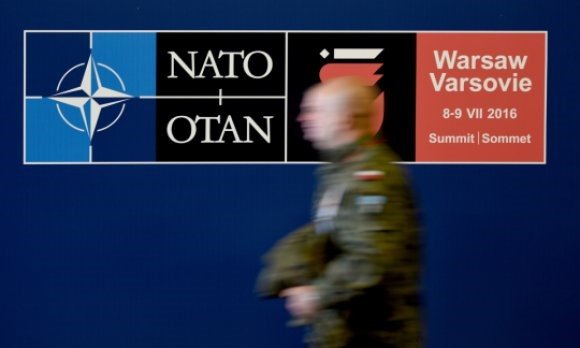
Angela Merkel spoke forcefully yesterday in support of a NATO troop build-up on its eastern flank:
Moscow had caused a loss of trust with the West by putting "the validity of law and the inviolability of frontiers" into question, the chancellor said."In the east, Russia has deeply unsettled our allies by its actions in Ukraine," Merkel said. "They now need a clear reassurance through the alliance," she added, urging "visible and reliable" solidarity with other NATO members.
Predictably, the chancellor was blasted by the Kremlin's representative in the Bundestag, Sahra Wagenknecht, who has repeatedly called for Germany to leave the NATO alliance:
Die Manöver in Osteuropa, die Hochrüstung, die Raketenbasen, die Truppenstationierung: Was kann Moskau darin denn anderes sehen als Kriegsvorbereitung? Auf jeden Fall wird so die Wahrscheinlichkeit und die Möglichkeit einer militärischen Eskalation mit der Atommacht Russland beträchtlich erhöht. Der Ernstfall, für den Sie in Osteuropa so lässig proben und von dem neuerdings in Militärkreisen wieder geredet wird, als wäre er ein kalkulierbares Ereignis – – Frau Merkel, ich finde es ja interessant, dass Sie sich mit Herrn Hofreiter unterhalten; aber ich würde es doch gut finden, wenn Sie meiner Rede wenigstens etwas Gehör verleihen würden. –
Unfortunately, more Germans agree with Sahra Wagenknecht than with the chancellor: 67% of Germans surveyed oppose the NATO troop deployments in the east and 88% support "more dialogue with Russia".
Jochen Bittner gets it exactly right in his Op/Ed piece in today's New York Times:
President Vladimir V. Putin could, for instance, stir up separatist feelings among ethnic Russians in Lithuania and provide weapons to the hotheads among them. Then all he would have to do is lean back and watch the most powerful military alliance in history disintegrate as it squabbles over how to react.
It’s easy to imagine how the scenario would play out: Poland and the Baltic countries would call for a strong response to pre-empt another annexation like that of Crimea. The Germans and French would call for negotiations with Moscow, doubting that Article 5 would be invoked. The Greeks, Italians and Spanish would make clear that their economies had already suffered enough from the sanctions on Russia after the annexation of Crimea. And much of the public across Europe, manipulated by Russian propaganda, would ask if the Russians weren’t somehow right in trying to support their fellows in the Baltic States. Wasn’t it actually the imperial United States who set all this up, some would argue, just like Washington’s agents were behind the coup in Kiev?
As we've seen, Putin is all in favor of "more dialogue" – as long as it doesn't stop him from annexing Crimea and occupying eastern Ukraine. NATO has lost its deterrence capability and most of its members seem more than willing to throw Poland and Baltic States under the bus.

0 comment
You write a log of nonsense here.
The destabilization of the Ukraine was a project of the USA. The best friends of the United States in Europe are the Ukraine and Poland. Both have similar Nazi governments. You may analyze alternatively the anti-Semitism in these countries.
Russian has no interests in occupying east-european countries in a long run, even if a Nato-truther like you claim it ever so often.
I support Angela Merkel’s position. if that makes me a “NATO Truther” then fine. Better than being a Kremlin troll.
“Both have similar Nazi governments.”
Oh those Jewish Nazis:
“Volodymyr Groysman is married and has two daughters and a son.[5] He is an active member of the Jewish community in his native Vinnytsia, and is the first Jewish prime minister of Ukraine.[12] Groysman’s grandfather, Isaac, survived the Holocaust by pretending to be dead after being dropped into a mass grave by Nazi troops.[12]”
https://en.wikipedia.org/wiki/Volodymyr_Groysman
Putin is a boss.
@sol1
Individual case empiricism. Consider the situation throughout the country.
@David
Merkel has been a gigantic opportunist since Honecker lifetime. She would never dare to do something against the interests of the (US- and EU-) elites. So she lubricates the NATO honey around the mouth and at the same time she signals Putin that the dialogue will not be demolished. The german export interest are sacred, Nato or not. Merkels opinion is neither fish nor meat.
@Wolfram,
All politicians are opportunists. Merkel is the most successful politician in a generation. I don’t care what her motivation is for supporting NATO as long as actions follow her words.
From a German perspective I would under absolutely no circumstances want Poland and the Baltics to be thrown under the Bus. Not without our fair share at least 😀
How I would love to see the hickup in Washington if Berlin and Moscow came to an agreement in this regard 😉
Honestly I think we have them in the fold pretty much via EU already. So no need for muscle-playing and supporting Nato maneuvers. I would offer those countries a strong German military presence under EU flag (strictly apart from Nato).
“Not without our fair share at least.”
@Zyme –
Maybe propose to Putin an exchange: Riga for Kaliningrad?
I’m with you on this David. And I don’t think that people who act all sarcastic and make light of the situation understand what the stakes are.
I do believe Königsberg should be returned. Surely there would be a way to come to an agreement with Russia.
However it may be advisable to station German EU troops in Poland beforehand. They might not be so inclined to invite us in afterwards.
I think it all boils down to how well Berlin can exert incluence via EU. Once that body falls apart, more traditional methods of foreign politics will become more attractive.
I would love to know what role this might play in the minds of decision makers in Eastern Europe – are they so forthcoming because of this?
…most of its members seem more than willing to throw Poland and Baltic States under the bus.- I strongly disagree!
Even in his wildest dreams Putin would not try to get Poland and the Baltic States into his Eurasion Empire. That does not mean he wouldn’t try to weaken any western alliance as long as the price is cheap. But in the end, for example, he’d rather have Germany integrated into NATO than let it go its own ways.
Russia is – as always – an overestimated giant with feet of clay. You mustn’t assume an ingenious masterplan behind every diplomatic effort or power projection. In many cases it is ‘trial and error’ politics, daily tactical moves, not knowing what the next day will bring. And most of that is just a show for the Russian population.