
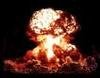
My worst fears are becoming a reality: Iran and the United States are on a confrontational course and a weak president sees military action as a last-ditch tactic to salvage a failed presidency. Meanwhile the American people seem destined to fall into the same trap as in 2003 when a majority supported the Iraq invasion based on bogus intelligence. Telepolis reports the results of a recent poll:
Trotz des Desasters im Irak und in Afghanistan würde fast die Hälfte der Amerikaner (48%) hinter Bush stehen und eine militärische Intervention unterstützen, wenn der Iran weiterhin waffenfähiges Uran anreichert. Das ist das erstaunliche Ergebnis einer aktuellen, von der der Los Angeles Times und Bloomberg in Auftrag gegebenen
Umfrage, die kurz vor der Mitteilung der iranischen Führung durchgeführt wurde, dass man mit der Anreicherung begonnen habe. Möglicherweise würden jetzt mit dem erneuten Druck der US-Regierung, scharf gegen den Iran vorzugehen, mehr einen Militärschlag befürworten. Zur Zeit der Umfrage lehnten noch 40% eine militärische Intervention ab.
Even though the New York Times reports today that Iran is at best years away from developing a nuclear weapon, the Bush adminstration has its Assistant Secretary of State Stephen Rademaker telling the press that it could have a nuclear bomb "in sixteen days". The neoconservative establishment has mobilized, just as it did in the run-up to the Iraq invasion. The racist commentator Mark Steyn see Iran as the potential leader of a Muslim empire (for which -bizarrely – he blames Jimmy Carter). Steyn urges the US to use "swift, massive, devastating force that decapitates the regime" because "our lives depend on it."
And that is precisely what the Bush administration is preparing for as the investigative reporter Sy Hersh has described in detail in the New Yorker magazine. The most frightening sections of Hersh’s article deal with the Pentagon’s consideration of the "nuclear option".
"One of the military’s initial option plans, as presented to the White House by the Pentagon this winter, calls for the use of a bunker-buster tactical nuclear weapon, such as the B61-11, against underground nuclear sites. One target is Iran’s main centrifuge plant, at Natanz, nearly two hundred miles south of Tehran. Natanz, which is no longer under I.A.E.A. safeguards, reportedly has underground floor space to hold fifty thousand centrifuges, and laboratories and workspaces buried approximately seventy-five feet beneath the surface. That number of centrifuges could provide enough enriched uranium for about twenty nuclear warheads a year. (Iran has acknowledged that it initially kept the existence of its enrichment program hidden from I.A.E.A. inspectors, but claims that none of its current activity is barred by the Non-Proliferation Treaty.) The elimination of Natanz would be a major setback for Iran’s nuclear ambitions, but the conventional weapons in the American arsenal could not insure the destruction of facilities under seventy-five feet of earth and rock, especially if they are reinforced with concrete. "
"The Pentagon adviser on the war on terror confirmed that some in the Administration were looking seriously at this option, which he linked to a resurgence of interest in tactical nuclear weapons among Pentagon civilians and in policy circles. He called it “a juggernaut that has to be stopped.” He also confirmed that some senior officers and officials were considering resigning over the issue. “There are very strong sentiments within the military against brandishing nuclear weapons against other countries,” the adviser told me. “This goes to high levels.” The matter may soon reach a decisive point, he said, because the Joint Chiefs had agreed to give President Bush a formal recommendation stating that they are strongly opposed to considering the nuclear option for Iran. “The internal debate on this has hardened in recent weeks,” the adviser said. “And, if senior Pentagon officers express their opposition to the use of offensive nuclear weapons, then it will never happen.”
The adviser added, however, that the idea of using tactical nuclear weapons in such situations has gained support from the Defense Science Board, an advisory panel whose members are selected by Secretary of Defense Donald Rumsfeld. “They’re telling the Pentagon that we can build the B61 with more blast and less radiation,” he said. "
So, the madmen that botch the Iraq war are seriously considering nuking Iran to prevent a portential nuclear threat. The B61-11 Bunker Buster bomb Hersh mentions has 30 times the yield of the Fat Man bomb the US dropped on Nagasaki, and it is not even certain that such a weapon could destroy a hardened, deep underground facility. The impact on the suface, however, would be devastating. The group Physicians for Social Responsibility modeled the effect of a 1.2- megaton bomb on the Iranian city of Isfahan. Here is an excerpt from their report (pdf) published in May 2005:
From the HPAC calculations, we estimate that within 48 hours of an … attack, over 3 million people would die as a result of the attack. About half of those would die from radiation-related causes, either prompt casualties from the immediate radiation effects of the bomb, or from exposure to fallout. For example, the entire city of Isfahan would likely be covered in fallout producing 1000 rems of radiation per hour, a fatal dose. Over 600,000 people would suffer immediate injuries of the kind described previously. …
…within 48 hours, prevailing winds would spread fallout to cover a large area in Iran, most of Afghanistan and then spread on into Pakistan and India. There is little likelihood, in most seasons, that rain would mitigate the spread of fallout.
In this scenario, over 35 million people in Iran, Afghanistan, Pakistan, and India would suffer significant radiation exposure of 1 rem per hour or above within four days of the use of the RNEP. At this rate, the 25 rem limit at which physical effects can be expected would be reached within 25 hours of first exposure, and the 100 rem limit at which more severe damage could be caused would be reached in only 4 days. (Given the lack of modern communications in this area, as well as the lack of advanced education available to the affected populations, it is unlikely that warnings would spread quickly enough to allow mitigating measures to be taken). Immediate effects would include skin burns and diarrhea secondary to gastro-intestinal cell damage. Long-term effects could include cancers. Many, if not all, of the approximately 20,000 American armed forces, intelligence and diplomatic personnel deployed in Afghanistan would be at risk of exposure at these radiation levels. While U.S. personnel could be evacuated, and would receive sophisticated medical care if necessary, this would not apply to the local population in most of the affected area.
In his New Yorker article, Hersh quotes a source close to the Pentagon saying that Bush believes ”that saving Iran is going to be his legacy”. If "saving Iran" means deploying tactical nuclear weapons, then the legacy of Bush may well be an orgy of death that would isolate the US as the world’s pariah for decades to come.
UPDATE: (Via TooMuchCookies) the international physicians group IPPNW has condemned the Nuclear Option contemplated by the Pentagon.

0 comment
All of a sudden even Afghanistan is a disaster now? Maybe the kind folk at Telepolis should start advocating for the retreat of the Bundeswehr and NATO forces that have been deployed in support of the aforementioned “disaster”, if that’s what it is…
It’s interesting. You heard about the Natanz facility being underground, with space for hundreds of centrifuges and being built without the IAEA gaining access to it during inspections. Yet, you are willing to give Iran a free pass when it comes to assigning the blame for the escalation of the situation, instead giving 100% credibility to the New Yorker article that reinforces your bias against the Administration.
The only justification you give for this is that “hey, Iran is years away from a nuclear weapon! No worries!” even when the circumstantial evidence against the regime in Teheran is piling up pretty damn quick. On top of that you simply ignore the rhetoric coming out of Iran lately and lay the blame entirely on a secret “mobilization” on the part of “neoconservatives”, as if they were some sort of secret society that kills puppies in their sleep or something. Please. Get serious. The evidence shown against Iran in the IAEA meeting was bad enough to send its case to the UNSC, and the UNSC has demanded that Iran stop its enrichment activities before the end of this month. They seem to be taking Iran quite a bit more seriously than you are, and I seriously doubt that they are puppets of the evil neoconservative government in Washington.
Assign blame, please do. But do us a favour and do try and condiment your reasoning with a bit of objective thought about the issue.