
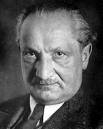
A professor at the University of Pennsylvania, Carlin Romano, has stirred up a hornet's nest by writing a crude hit job on Martin Heidegger in the venerable Chronicle of Higher Education. For Professor Romano, Heidegger is nothing more than a fraud, a pseudo-philosopher, who, nonetheless has duped the academic establishment:
"How many scholarly stakes in the heart will we need before Martin
Heidegger (1889-1976), still regarded by some as Germany's greatest
20th-century philosopher, reaches his final resting place as a
prolific, provincial Nazi hack? Overrated in his prime, bizarrely
venerated by acolytes even now, the pretentious old Black Forest
babbler makes one wonder whether there's a university-press equivalent
of wolfsbane, guaranteed to keep philosophical frauds at a distance."
For Romano, Heidegger was THE philosopher of Nazism:
"Heidegger "devoted himself to putting philosophy at the service of
legitimizing and diffusing the very bases of Nazism," and some of his
1930s texts surpass those of official philosophers of Nazism in "the
virulence of their Hitlerism." …Heidegger has helped to conceal the deeply
destructive nature of the Hitlerian undertaking by exalting its
'grandeur.'"
Romano's hack assessment of Heidegger is wrong on so many levels. Firstly, there is no coherent "Nazi Philosophy". If there were, it would found more in the drivel of Moeller van den Brueck than in the writings of Heidegger, whose work was incomprehensible and simply tolerated by the Nazis – hardly venerated. Heidegger's seminal work Sein und Zeit was published in 1926, seven years before the Nazi seizure of power. The book was immediately recognized as a major achievement in philosophy by Edmund Husserl (his mentor), Hannah Arendt (his protégé and lover), and the philosophers Karl Jaspers and Hans-Georg Gadamer – all of whom were persecuted by the Nazis.
Even if one agrees with Romano that Heidegger was a buffoon who deserves our ridicule rather than adulation, one cannot ignore his profound influence on postwar thinking and intellectual movements such as existentialism and structuralism. No Heidegger, no Sartre – which, for Romano might have been a good thing. But what about Heidegger's influence on the American Richard Rorty? On Charles Taylor? Have these eminent thinkers also been totally duped?
Among other things, Heidegger was one of the great innovators of the German language, contributing more than 200 neologisms in Sein und Zeit alone. Many of these have been condemned as obscure and grotesque, but Heidegger was determined to revolutionize philosophy by violently transforming its most fundamental tool. Here he attracted the attention of that other great 20th century German language revolutionary – the poet Paul Celan. Celan, whose family was murdered by the Nazis and felt that the German language was debased by them, was determined to de-familiarize and rejuvenate his Muttersprache/Mördersprache. In 1966 he made a pilgrimage to visit Heidegger in his Black Forest hut above Freiburg. Celan memorliazed the meeting and walk they took together in the forest in the poem Totnauberg.
Before we consign Heidgger to the ash heap, or banish his work – as Romano seems to want to do – I suggest we reexamine him through the eyes of those who, like Paul Celan, were profoundly influenced by him.
