
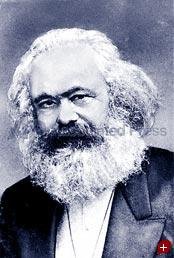
In 1857 Wall Street experienced a serious financial meltdown which soon spread to all sectors of the fledgling American economy and then led to economic collapse in London and Hamburg. An excited Karl Marx wrote to his friend Engels: " Der American crash ist herrlich und noch lange nicht vorbei", (The American crash is wonderful and and nowhere near over.") Just as he predicted, capitalism appeared to be collapsing under its own inherent contradictions. But Wall Street soon recovered and so did capitalism. For the past 150 years Marxism has been pronounced dead many times, but now – with Wall Street in a downward spiral and neo-liberal free market theology completely discredited – Marx’s critique of capitalism is making a huge comeback.
This week none other than the Archbishop of Cantebury appovingly invoked Marx as he looked at the devastation of the financial landscape:
Karl Marx, the intellectual father of modern communism, was partly
right in his criticism of capitalism, Archbishop of Canterbury Rowan
Williams has said in an article about the crisis hitting the world’s
financial markets.
"Marx long ago observed the way in which unbridled capitalism became
a kind of mythology, ascribing reality, power and agency to things that
had no life in themselves; he was right about that, if about little
else," Williams wrote in the article to be published in the September
26 edition of the British weekly magazine The Spectator, and also
available on the publication’s website.
At the same time, the Church of England’s second most senior cleric,
Archbishop John Sentamu of York, condemned financial traders who had
profited from the financial crisis threatening world stability as
"asset strippers and bank robbers."
In Germany, consider the story of "Red Oskar" Lafontaine, who has led the surging LEFT party (die LINKE) to its current position as the third largest political party. Ten years ago Lafontaine led the Social Democrats (SPD) and was Germany’s finance minister. He earned the wrath of American and British central bankers as well as of the media in Germany for fighting against the massive deregulation of the global capital markets and the unchecked activities of the hedge funds. He recalled this period in a recent interview with German radio:
"Vor fast zehn Jahren war ich Bundesfinanzminister und habe eine
Regulierung der Weltfinanzmärkte gefordert",… "Das war damals, wenn man so will, eine
Todsünde, weil mehr oder weniger alle über mich her fielen und sagten,
das sei also eine völlig antiquierte und nicht zeitgemäße
Betrachtungsweise. Es gab dann massive Angriffe auf meine Person." (Ten years ago I was the German finance minister and demanded regulations for the global financial markets. At that time this was considered a deadly sin, and everyone jumped on me and said that was a completely antiquated way to think that had nothing to do with the modern markets. I was subjected to massive personal attacks.")
Lafontaine resigned his office and left the SPD. Today he looks like a genius. Last month he again was the object of scorn for suggesting that certain aspects of Marx’s Communist Manifesto were completely relevant to today’s economy. He committed yet another sin by calling for the "appropriation" (Enteignung) of certain private enterprises by the state – sounding much like a German version of Hugo Chavez. But now that George W. Bush has nationalized an entire sector of the American economy, "Red Oskar" Lafontaine – channeling Karl Marx – doesn’t sound so crazy after all. Even Marx himself might have been impressed by Bush’s revolutionary zeal. Why stop at the financial institutions?
