
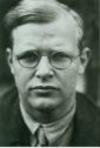
Dietrich Bonhoeffer was born 100 years ago today in Breslau. I’ve just finished reading Renate Wind’s brief book on his life: Dem Rad in die Speichen fallen: Die Lebensgeschichte des Dietrich Bonhoeffer (English trans. DIetrich Bonhoeffer: A Spoke in the Wheel). The title of the book comes from an essay Bonhoeffer wrote in 1933: "Die Kirche vor der Judenfrage" :
Die Kirche ist den Opfern jeder Gesellschaftsordnung in unbedingter Weise verpflichtet auch wenn sie nicht der christlichen Gemeinde zugehören. »Tut Gutes an jedermann.« In beiden Verhaltungsweisen dient die Kirche dem freien Staat in ihrer freien Weise und in Zeiten der Rechtswandlung darf die Kirche sich diesen beiden Aufgaben keinesfalls entziehen. Die dritte Möglichkeit besteht darin nicht nur die Opfer unter dem Rad zu verbinden sondern dem Rad selbst in die Speichen zu fallen .
(The church has an unconditional obligation tothe victims of any ordering of society, even if they do not belong to the Christian community. ‘Do good to all men.’ In both of these courses of action, the church serves the free state in its free way, and at times when laws are changed teh church may in no way withdraw itself from these two tasks. The third possibility is not just to bandage the victims under the wheel, but to put a spoke in the wheel itself.)
Dr. Wind’s book is light on theology: Bonhoeffer’s book Nachfolge (The Cost of Discipleship) receives only a few sentences of discussion. But she does an excellent job of putting Bonhoeffer’s life in an understandable historical context, and highlighting the events that influenced his personal development and growth as a theologian: his privileged upbringing in a liberal bourgeois family, his encounter with Karl Barth at a young age and introduction to Dialectical Theology, his discovery of the the social gospel in New York and experience of the living church at the Abysynnian Baptist Church in Harlem. Dr. Wind then describes how after the Nazi seizure of power the Lutheran Church in Germany split into the grotesque fascist parody of the Deutsche Christen on the one hand, and the Bekennende Kirche (Confessing Church) on the other, and how the Bekennende Kirche itself was eventually forced to capitulate to the Nazis.
In her book, Dr. Wind reminds us of other Christians – less famous than Bonhoeffer – who paid the ultimate price for remaining true to their faith under Nazi tyranny: Friedrich Weissler, tortured to death at the Sachsenhausen concentration camp in 1937 because he was born a Jew; Hermann Stöhr and Martin Gauger – executed for their pacificism and refusing military conscription; Sophie and Hans Scholl, who along with their friend Christoph Probst, were guillotined for distributing leaflets urging Christian resistance. They followed the path of what Bonhoeffer called "costly discipleship".
It is after Bonhoeffer is arrested and imprisoned that he comes into his own as an original thinker. His love relationship with Maria von Wedemayer and his feeling of solidarity with the other inmates – many of whom were non-Christian, even avowed Communists, caused him to radically rethink the meaning of Christ in the world. Renate WInd calls this development ‘In der Diesseitigkeit des Lebens glauben zu lernen‘ (learning to have faith in the here and now of living). Bonhoeffer wrote:
Nicht der religiöse Akt macht den Christen, sondern das Teilnehmen am Leiden Gottes im weltlichen Leben…Jesus ruft nicht zu einer neuen Religion auf, sondern zum Leben. (it is not the religious act that defines the Christian, but rather participating in god’s suffering in the world…Jesus does not call for a new religion, but rather to life)
In prison Bonhoeffer gave the provocative outline of a religionless Christianity, but he was executed before he could develop it fully. Today we look at the fragments from his prision writings (Widerstand und Ergebung) and the example of his abbreviated life and see the possiblity for how to live as a Christian in a world where Religion has again become a force for darkness and the degradation of the spirit.

0 comment
PBS has a documentary and links to a bonhoeffer website:
http://www.pbs.org/bonhoeffer/
Is it good?