
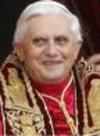
Benedict XVI delivered his Easter address yesterday to tens of thousands of pilgrims, tourists and Romans gathered in St. Peter’s Square. You can read the entire Urbi et Orbi in English here and in German here. What is noteworthy is that Benedict is among the skeptics with respect to President Bush’s SURGE (i.e. escalation of war) in Iraq:
"In the Middle East, besides some signs of hope in the dialogue between Israel and the Palestinian authority, nothing positive comes from Iraq, torn apart by continual slaughter as the civil population flees."
Benedict’s call for peace in his Easter address has attracted notice. But his long term project of "re-Christianizing" Europe may be running into problems. The journalist Russell Shorto has an excellent long piece in the New York Times Magazine on the Pope’s battle with Europe secularism. A comparison of church attendance in Europe and America is instructive:
Comparing survey data on church attendance in Europe and the United States is doubly revealing. In Western Europe as a whole, fewer than 20 percent of people say they go to church (Catholic or Protestant) twice a month or more; in some countries the figure is below 5 percent. In England, fewer than 8 percent go to church on Sundays. In the U.S., by contrast, 63 percent say they are a member of a church or synagogue, and 43 percent of respondents to a 2006 Gallup Poll said they attended services weekly or almost weekly. But the story is more complicated than this. “The interesting fact is that people responding to questions about religion lie in both directions,” says the Spanish sociologist José Casanova, who is chairman of the sociology department at the New School for Social Research in New York and an authority on religion in Europe and the United States. “In America, people exaggerate how religious they are, and in Europe, it’s the other way around. That has to do with the situation of religion in both places. Americans think religion is a good thing and tend to feel guilty that they aren’t religious enough. In Europe, they think being religious is bad, and they actually feel guilty about being too religious.”
Benedict’s emphasis on chuch hierarchy, on top-down decrees on what Catholics should believe and how they should behave, may be undermining his own mission. Shorto mentions Ratzinger/Benedicts old friend and "heretic" Hans Küng:
The sex-abuse issue is part of what Hans Küng calls “the long-term structural problems of the church,” most of all its hierarchical decision-making process, which has kept church leaders looking out for their own and which ensures a broad gulf between what the cardinals and the pope decree and the way most Catholics live. Like John Paul II, Benedict XVI has shown little interest in reforming some of the basic policies affecting the lives of ordinary Catholics. “We can lament the rising divorce rate, but it’s a reality,” Pecklers said. “On Sunday mornings, the people in the pews, in Europe or America, are very often divorced or gay or are using birth control. Or else they’re not in the pews; they’ve left the church.” As Küng wrote last year, “For as long as the absolute primacy of Rome prevails, the pope will have most of Christianity against him.” That may be too strong to apply to Catholics everywhere, but it seems to ring true for Western Europe.

