
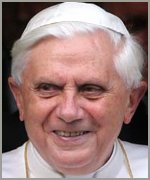
Pope Benedict has issued his third encyclical – Caritas in veritate
(Charity in Truth) – which addresses the global economy and its
inequalities. It is a long, dense piece and can be downloaded from the Vatican's Web site (English,Deutsch) .
The encyclical is sure to generate a great deal of controversy, since
the pope is calling for nothing less than a new economic order based on
economic justice and a more equitable distribution of wealth.
Its publication is obviously timed to coincide with the G8 and the
summit’s focus on economic repair, aid to poor countries, food security
and climate change.
Economics, Pope Benedict writes, is not just the pursuit of profits,
but must be based on an ethical pursuit of the "common good".
Profit is useful if it serves as a means towards an end that
provides a sense both of how to produce it and how to make good use of
it. Once profit becomes the exclusive goal, if it is produced by
improper means and without the common good as its ultimate end, it
risks destroying wealth and creating poverty.
He decries the "corruption" of the political class (not just in the
wealthy countries) and the unethical behavior of financiers and their
institutions as well as the exploitation of workers by multinational
corporations.
Corruption and illegality are unfortunately evident in the conduct
of the economic and political class in rich countries, both old and
new, as well as in poor ones. Among those who sometimes fail to respect
the human rights of workers are large multinational companies as well
as local producers. International aid has often been diverted from its
proper ends, through irresponsible actions both within the chain of
donors and within that of the beneficiaries. Similarly, in the context
of immaterial or cultural causes of development and underdevelopment,
we find these same patterns of responsibility reproduced. On the part
of rich countries there is excessive zeal for protecting knowledge
through an unduly rigid assertion of the right to intellectual
property, especially in the field of health care. At the same time, in
some poor countries, cultural models and social norms of behaviour
persist which hinder the process of development.
In a passage sure to displease the editors of the Wall Street
Journal, the Pope calls for an equitable distribution of wealth and
protection of workers' rights in every nation:
Lowering the level of protection accorded to the rights of workers,
or abandoning mechanisms of wealth redistribution in order to increase
the country's international competitiveness, hinder the achievement of
lasting development.
It is important to emphasize that Pope Benedict is not calling for a
wholesale socialization of the world economy: he recognizes the power
of markets in wealth creation. But he is highly critical of the
neo-liberal ideal of the unfettered markets. Markets must be regulated
in a "God-centered" economy for the common good. Benedict even goes so
far as to advocate a new supranational governing body to oversee and
enforce a more just global distribution of wealth and protect poorer
nations.
This seems necessary in order to arrive at a political, juridical
and economic order which can increase and give direction to
international cooperation for the development of all peoples in
solidarity. To manage the global economy; to revive economies hit by
the crisis; to avoid any deterioration of the present crisis and the
greater imbalances that would result; to bring about integral and
timely disarmament, food security and peace; to guarantee the
protection of the environment and to regulate migration: for all this,
there is urgent need of a true world political authority
Pope Benedict has written a very provocative piece with his Third
Encyclical. I don't agree with everything here, but the central
argument strikes me as correct and just – far more radical than any
"solutions" put forward by US politicians – Republican OR Democrat (who
would dare speak openly about wealth redistribution?).
Caritas in veritate lacks the passion and visionary power of Deus caritas est (God is Love – Benedict's first encyclical), and I miss the broad discussion of Western philosophy of the second encyclical (Spe Salvi – In hope we are saved). But I disagree with the assessment of Matthias Drobinski in Sueddeutsche Zeitung – Der weltfremde Papst . Dobrinski calls this encyclical a "disappointment" (Enttäuschung) and sees Benedict as being "out of touch" (weltfremd). On the contrary, Caritas in veritate displays an impressive grasp of complex economic issues – from hedge funds to globalization and business process outsourcing.
