
In the face of the massive destruction in Lebanon and the stubborn persistence of Hezbollah, a new strand of neoconservative thinking has surfaced which neatly explains both the failures of the Israel in Lebananon and the US in Iraq: We are too civilized to wage war effectively. These neoconservative pundits are urging wholesale slaughter as the only solution. John Podhoretz made this case recently in the prestigious New York Post:
"Could World War II have been won by Britain and the United States if the two countries did not have it in them to firebomb Dresden and nuke Hiroshima and Nagasaki? Didn’t the willingness of their leaders to inflict mass casualties on civilians indicate a cold-eyed singleness of purpose that helped break the will and the back of their enemies? Didn’t that singleness of purpose extend down to the populations in those countries in those days, who would have and did support almost any action at any time that would lead to the deaths of Germans and Japanese? "
The question is: did the firebombing of Dresden hasten the end of the war? Did the mass killing of civilians in Germany and Japan have any strategic value to the war effort? In the case of Germany, Jörg Friedrich is pretty convincing his history of the airwar – Der Brand – that the bombing had little impact on the military-industrial infrastructure of Germany and, if anything, rallied support for the Nazi war effort. In other words, the killing of 600,000 non-combatant Germans probably prolonged the war. And the use of atomic weapons on Hiroshima and Nagasaki were clearly war crimes of the highest magnitude. Especially the bomb on Nagasaki was completely unnecessary, as James Carroll writes today in the Boston Globe:
The Nagasaki principle comes in two parts. It can operate at the level of close combat, driving fighters to commit atrocities that, in normal conditions, they would abhor. It operates equally at the level of the commanders, leading them to order strikes out of desperation, frustration, or merely for the sake of “doing something." Such strikes draw equivalent responses from the other side until the destruction is complete. After the fact, massive carnage can seem to have been an act for which no one is responsible, like the result of a natural disaster.
The fact is, the United States has never backed off from optimizing killing ,as Podhoretz has claimed. How many Vietnamese were killed in carpet bombing of Hanoi? Lilianjames writes about US war crimes in Vietnam, and I agree with her conclusion:
It’s doubtful that this or past administrations will ever be held accountable for their serial violations of international laws and treaties, and domestic laws—not to mention human rights abuses and poisons dumped in the oceans and across the globe. But regardless of what the government does or doesn’t do, there is something the American people can do: accept moral responsibility for these crimes, repudiate them, demand accountability from government, and fight for the rule of law. That, or be a nation of silent and willing perpetrators, living a lie—there are only two choices.
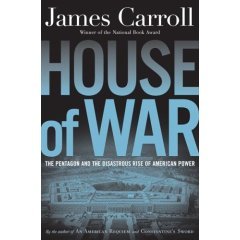
James Carroll’s history of the Pentagon – House of War – is a masterful portrait of the guiding force in American policy (both domestic and foreign) since World War II. I haven’t finished all 650 pages, but Carroll describes how the military-industrial complex has come to permeate every institution in America – just as President Eisenhower had warned in his Farewell Address. Carroll’s story is also highly personal, since his father was a high-ranking official in the Pentagon. House of War helps explain why American policy is dominated by types like Podhoretz, who see killing on a massive scale as the solution for all of America’s problems.
UPDATE: Interesting insight here into another Neocon member of the "mass slaughter" contingent – torture advocate Charles Krauthammer.

0 comment
“House of War helps explain why American policy is dominated by types like …”
Does it explain why US politics is NOT dominated by “other types”?
What’s wrong with US democracy, at least on the federal level?