
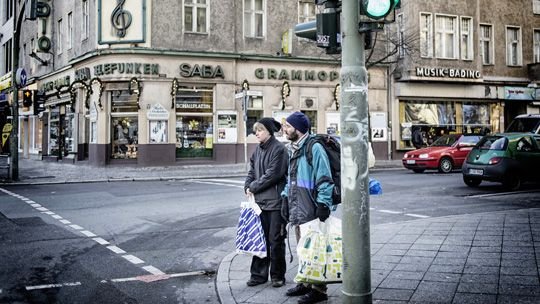
DIe Zeit has two interesting articles that illustrate the growing divide between the affluent and the poor in Europe's wealthiest economy. Zeit reporter Henning Sußebach and a female companion went underground for a week as a homeless couple in need of shelter (she is pregnant) and food in two very different places. What they experience is eye-opening, but not entirely unexpected. The experiments take place a year apart during the Advent season- the season of giving.
In December 2011 Henning and Viola turn up as a homeless couple in need of assistance in Kronberg, a wealthy enclave of bankers, hedge fund managers and tax attorneys just outside of Frankfurt (a suburb comparable to Greenwich, Connecticut (Maria und Josef im Ghetto des Geldes). They walk in the rain from one luxury hotel to another looking for a place to sleep – but there is no room at the inn. For the most part, the hotel staff is horrified at their presence, afraid the couple's raggedy appearance would disturb the well-heeled guests. Mostly, the couple is invisible in this affluent community – the Mercedes and the SUVs whizz by them with hardly anyone taking notice. Occasionally a child will blurt out what the parents are surely thinking: "Mama! Da sind wieder die faulen Feiglinge." ("there they are again, the lazy cowards.") For in the winner-take-all society, the losers have only themselves to blame for their dire predicament.
The couple does get some help – from a Turkish gardener speaking broken German, from a low-level hotel employee, from a maid in the one of the bankers' mansions. The local Lutheran minister, working on his Christmas sermon, turns them away, but does give them a bag of food and 20 euros.
Finally, the couple crashes a charity event at one the posh hotels:
Es gibt zahllose Charity-Zirkel in Kronberg, aufwendig inszeniert und dokumentiert. Im Internet finden sich Bilder von Vorstandschefs in karger Krankenhauskulisse und Managern mit dunkelhäutigen Babys auf dem Arm. Die Konkurrenz scheint so groß zu sein, dass man schon Mehrfachbetroffenen helfen muss, um überhaupt aufzufallen. Nur Kinder in Bangladesch reichen nicht, sie müssen auch noch blind sein. Indirekte Hilfe wird bevorzugt – also verbunden mit Festlichkeit und Spenden nach möglichst weit weg. Bangladesch, Sri Lanka, Peru.
(There are countless charity organizations in Kronberg, elaborately staged and documented. In the Internet you find pictures of board members in primitive hospitals and managers holding dark-skinned babies. The competition is apparently so great that you need to find those who are doubly disadvantaged to help if you want to get noticed. It's not enough to help children in Bangladesh – they need to be blind as well. Indirect help is much preferred – combined with festivities and donations for those as far as away as possible: Bangladesch, Sri Lanka, Peru. )
One year later, in December 2012, Henning Sußebach and a female reporter decide to try out their homeless experiment in one of the worst slums of Berlin – Neukölln (Maria und Josef in Neukölln ). Neukölln is a neighborhood of mostly immigrants and is considered a high-crime area. Here the couple has no difficulty finding a place to sleep or a hot shower. People give them food, money, dry socks. They are not invisible, for the residents identify them as their own.
In Neukölln kann niemand dem anderen ausweichen. Bleibt man einfach mal sitzen im Rein und Raus der Teestuben, wird klar, wie viel Verbindlichkeit sich im scheinbar unverbindlichen Trubel versteckt: Viele Gäste werden mit Handschlag über die Theke hinweg begrüßt, der Chef erkundigt sich, wie es den Kindern geht, Schüler brüten über ihren Hausaufgaben – und die Frage »Was geht, Alter?« ist mehr als Ghettokid-Folklore. Uns helfen vor allem jene, die »parterre geblieben« sind, wie die Berliner sagen, auch charakterlich nicht abgehoben.
(In Neukölln there is no way of avoiding each other. Just try sitting in the hustle and bustle of a tea room and it is clear how many human connections there are in the apparent confusion. Many patrons are greeted with a handshake across the counter, the boss asks how the kids are, the children struggling with their homework – and just asking the question "How are things going, old man?" is more than just a ghetto-kid folk tale. It is those at the "bottom of the stairs", as the Berliners say, who are the most eager to help us.)
So what was the point of this "experiment", and what was learned? It is the old story of 'The Rich Young Man / der reiche Jüngling from the Bible (Luk. 18, 18-23; Mark. 10, 17-22; Matth. 19, 16-22):
"Als Jesus auf die Straße hinausgetreten war, kam ein vornehmer Jüngling herzu, kniete vor ihm nieder und fragte ihn: “Guter Meister! was soll ich Gutes tun, damit ich das ewige Leben erlange?” Jesus entgegnete ihm: “Was nennst du mich gut? (Und) was fragst du mich über das Gute? Niemand ist gut als nur einer, Gott. Willst du aber zum Leben eingehen, so halte die Gebote.” Er sprach zu ihm: “Welche?” Jesus antwortete: “Die Gebote kennst du: Du sollst nicht töten, nicht ehebrechen, nicht stehlen, kein falsches Zeugnis geben, nicht betrügen. Ehre deinen Vater und deine Mutter und liebe deinen Nächsten wie dich selbst.” Der Jüngling antwortete ihm: “Meister, das alles habe ich von Jugend auf beobachtet; was fehlt mir noch?” Als Jesus dieses hörte, blickte er ihn liebreich an und sprach: “Eins fehlt dir noch: Willst du vollkommen sein, so geh hin, verkaufe alles, was du hast, und gib es den Armen, und du wirst einen Schatz im Himmel haben; dann komm und folge mir nach.” Als der Jüngling das hörte, ward er betrübt und ging traurig hinweg; denn er besaß viele Güter."

0 comment
Two very interesting [& related] posts to end the old year & begin the new.
Thanks
I read an interesting speculation by Noam Chomsky that the present austerity system being enforced in Europe is so wrong is economic terms that it must have some wider goal not discussed. He suggests the dismantlement of the post-war welfare state system.
[Presumably in order to compete with China & the U.S.]
Cheers.