
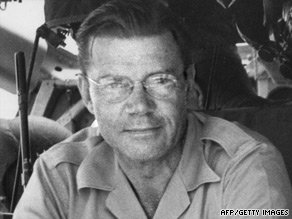
Robert McNamara died last week at the age of 93. He will forever be remembered as the "architect" of the Vietnam War, in which more than a million non-combatant Vietnamese civilians died. But it is important to remember that McNamara got his first taste of war in World War II, where he first put his tremendous statistical skills to use to kill civilians. As a young officer in the Department for Statistical Control, McNamara showed General Curtis LeMay efficient ways of delivering unprecedented quantities of incendiaries ("firebombs") to Hamburg, Dresden and other German cities and finally to all major Japanese cities.
Later, McNamara admitted that he and LeMay were guilty of war crimes. When recounting a bombing raid of Tokyo that killed more than 100,000 Japanese civilians in one night, McNamara said. "Well, I was part of the mechanism that recommended it (the bombing raid). I analyzed the bombing operations, and how to make them more efficient. …. LeMay said if we'd lost the war, we'd all have been prosecuted as war criminals. And I think he's right. He, and I'd say I, were behaving as war criminals."
Historian Howard Zinn was a young bombardier aboard a B-17 with the 490th Bombardment Group and flew numerous bombing missions in Germany, delivering the incendiaries organized by McNamara. But Zinn drew different lessons from his experiences and led the protests against "McNamara's War" in the late 1960's and early 1970s.
Listen to Howard Zinn's comments on the death of Robert McNamara.
