
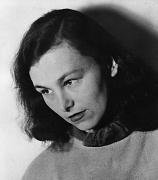
Ilse Aichinger's Die größere Hoffnung is included in Sueddeutsche Zeitung's series of the 100 greatest novels of the 20th century. The book (the title in English is literally "The Greater Hope") was published in Vienna in 1948. An English translation – Herod's Children – was released in 1963 to mixed reviews. Like all great Austrian writers, Aichinger plays with language – in a sense, the novel is about the language of tyranny and horror- so it is nearly impossible to translate.
Aichinger somehow managed to survive in Vienna during the war as a Mischling – or half-Jew. So Die größere Hoffnung is in part her attempt to come to terms with that terrible personal experience. What distinguishes this novel from other works of fiction on the Holocaust is the narrative perspective – the point of view is that of a child – and the poetic style. Aichinger uses expressionistic techniques, fairy tales, Kafka-like parables, and myths to tell the story. In fact, I did keep thinking of Kafka while reading Die größere Hoffnung. In a sense, Aichinger writes about the world that Kafka anticipated in his work; her novel is a completion (Vollendung) of his vision.
The main character is 11-year old Ellen who in the first chaper is visiting the consulate in the middle of the night to obtain a visa to join her mother in America. But Ellen has no sponsor and the consul tricks her into believing that only she can grant herself a visa. For the most part, the adults in Die größere Hoffnung only wish to bring harm to or trick the children at the center of the story. The first chapter bears the title Die grosse Hoffnung / The Great Hope, and the novel shows how time and again Ellen's hopes – and those of the other children – are dashed: there is no escape from their fate. And yet, the children never lose hope. They make plans and envision happier futures for themselves to the end.
Rejected by the other (Aryan) children because of her Mischling status, Ellen joins a group of Jewish children who have been driven from from every public playground and park and are forced to play in a graveyard. Aichinger doesn't use the word Jew; instead these are the children "with the wrong grandparents". Because they have four "wrong grandparents", they are forced to wear the star. The other children view Ellen with suspicion since she does not have a star, having only two "wrong grandparents". But Ellen longs to wear the star as well so she can be accepted by the others. Much of the novel is about how the children seek to understand the meaning of the star. They reenact the Nativity over and over, believing that the Star of Bethlehem represents the true meaning of the star. Adults are drawn into the Nativity play, but they are only there to keep the children preoccupied until they can be rounded up by "die geheime Polizei" – the secret police. And so the children learn the truth about the star, although Ellen, at the very end of Die größere Hoffnung as she is torn apart by a grenade, comes to find yet another, more hopeful meaning in the morning star she sees rising above the bridge of hope.
At the center of Die größere Hoffnung is the chapter entitled "Death of the Grandmother". Ellen's mother has left for America, so she lives with her "wrong" – that is Jewish – grandmother. The grandmother wishes to die rather than be arrested and deported and so enlists Ellen's aid in committing suicide. In actual life, Ilse Aichinger's grandmother was arrested and deported to the death camp during the final days of the war. She watched from a bridge as her grandmother was transported away.
Aichinger wrote: "Man überlebt nicht alles, was man überlebt." (You don't survive everything that you survive)
She was asked about this in a 1996 interview in Die Zeit:
Zeit: Was haben Sie nicht überlebt? ILSE AICHINGER: Den Anblick meiner Großmutter im Viehwagen auf der Schwedenbrücke in Wien. Und die Leute um mich herum, die mit einem gewissen Vergnügen zugesehen haben. (Zeit: What didn't you survive? Ilse Aichinger: The sight of my grandmother in the cattle truck on the Sweden Bridge in Vienna. And the people standing around me who watched with a certain amount of satisfaction.)
Ilse Aichinger has written stories, essays, plays and poetry. Die größere Hoffnung remains her only novel.
