
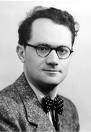
As a student of German Exile Literature, I am enjoying immensely reading Michael Lentz's novel Pazifik Exil (review to follow in due course). Lentz takes the readers into the minds of Heinrich Mann, Brecht, Feuchtwanger and – most deliciously – Alma (Mahler Gropius) Werfel as they flee Europe and find refuge in America. In the first chapter, Lentz introduces the American Varian Fry, who arranges a difficult passage by foot over the Pyrenees for Franz & Alma Werfel, Heinrich, Nelly and Golo Mann. One of Varian Fry's volunteers, Dick Ball, actually carries Werfel part of the way on his back.
I'm happy that Michael Lentz reminds us of this remarkable man; Varian Fry displayed the best of the American can-do attitude: he recognized an emergency situation to save the lives of writers, scientists, artists, musicians who faced certain imprisonment or death as Hitler's armies spread across Europe. Varian Fry founded the Emergency Rescue Committee in Marseille in 1940 and helped more than 2,000 people escape across the border into neutral Portugal, where many found passage to the United States. Fry's effectiveness was due to his understanding of the bureaucratic mentality: he obtained the necessary documents, letters, stamps, etc for his clients, and when he couldn't get them legally he simply forged them. The list of those he saved reads like a Who's Who of European arts and letters: Hannah Arendt, Ernst-Josef Aufricht, Georg Bernhard, André Breton, Marc Chagall, Marcel Duchamp, Max Ernst, Lion Feuchtwanger, Leonhard Frank, Konrad Heiden, Heinz Jolles, Wifredo Lam, Wanda Landowska, Jacques Lipchitz, Alma Mahler-Werfel, Heinrich Mann, André Masson, Walter Mehring, Otto Meyerhof, Soma Morgenstern, Hertha Pauli, Alfred Polgar, Hans Sahl und Franz Werfel. To be sure, he was not always successful: Walter Benjamin didn't make it across the mountain passage on his first attempt, and committed suicide out of despair.
"If I have any regret at all about the work we did,
it is that it was so slight. In all we saved some two thousand human
beings. We ought to have saved many times that number. But we
did what we could. And when we failed, it was all too often because of
the incomprehension of the government of the United States. It was not
until 1944 that the President created the War Refugee Board, to do in a big
way, and with official backing, what we had tried to do in our little way,
against constant official opposition. But then it was too late" – Varian Fry (quoted from Varian Fry in Marseille).
See also two related blog posts of mine: Dorothy Thompson: Fearless Friend of Free Germany and Salka Viertel's Kindess of Strangers.

0 comment
Wow sounds like an exciting read.
It takes a special kind of person to do this kind of work. These people were lucky. Was Fry Swiss? That’s a Swiss name. My husband became a master at dealing with bureaucrats during the time we lived in Switzerland. His ability to make sure every “i” is dotted and every “t” crossed has been invaluable to us.
Hattie, I don’t believe he was Swiss. Here is an excerpt from an online biography:
“The son of a liberal Protestant Wall Street stockbroker, he was constantly in trouble at boarding school and at Harvard, where he founded the literary magazine Hound & Horn with Lincoln Kirstein to champion modernist authors like Joyce and Eliot, but also managed to get himself expelled for several months before graduating in 1931. A trip to Germany in 1935 turned him into an ardent anti-Nazi.”
And this description makes him out to be rather un-Swiss in his behavior:
“He liked to conduct meetings in his underwear, drank whenever he got the chance, cracked jokes while life-and-death decisions were being made. When a group of Surrealists descended on his villa like a bunch of frolicsome kindergartners, he joined them in their singing, dancing and game playing, even as the Gestapo was nipping at their heels. ”It sometimes seemed as if Fry was hosting a giant party,” Isenberg writes. Fry himself said: ”There’s a hell of a lot of fun — though that’s not quite the word — in rescue work. . . . It’s stimulating to be outside the law. . . . And as for depression, anxiety — all that pattern simply vanishes.”
Maybe a free Swiss?
(laughing to myself)
Actually I have seen some pretty bizarre Swiss goings on, even in Switzerland. But that does not mean these bizarros did not know how to deal with bureaucrats!
A had a friend who was married to a Swiss who liked to target practice in his hallway. He shot a hole in my friend’s expensive mink coat. When he got tired of working he figured out how to get disablility for an imaginary disease and got away with it for years.
But basically Fry was American, I guess.