
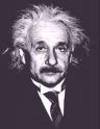
These are heady days indeed for fans and scholars of Albert Einstein. Walter Isaacson has a great new biography out – Einstein: His Life and Universe – in which Einstein’s scientific achievements as well as his valiant advocacy for peace and justice are explored. But did you also know that Einstein was involved in the struggle for civil rights for black Americans? The Harvard University Gazette has a piece on this little-known aspect of Einstein’s life in America:
In 1946, the Nobel Prize-winning physicist traveled to Lincoln University in Pennsylvania, the alma mater of Langston Hughes and Thurgood Marshall and the first school in America to grant college degrees to blacks. At Lincoln, Einstein gave a speech in which he called racism “a disease of white people,” and added, “I do not intend to be quiet about it.” He also received an honorary degree and gave a lecture on relativity to Lincoln students.
The reason Einstein’s visit to Lincoln is not better known is that it was virtually ignored by the mainstream press, which regularly covered Einstein’s speeches and activities. (Only the black press gave extensive coverage to the event.) Nor is there mention of the Lincoln visit in any of the major Einstein biographies or archives.
In fact, many significant details are missing from the numerous studies of Einstein’s life and work, most of them having to do with Einstein’s opposition to racism and his relationships with African Americans.
No doubt Einstein’s first-hand experience of anti-Semitism in Germany had something to do with his deep empathy for the plight of black Americans. His adopted home of Princeton, New Jersey was highly segregated in the 1940s and 1950s. But the African-American physicist Sylvester James Gates Jr. sees Einstein’s involvement in civil rights as an outcome of his scientific imagination:
Einstein’s approach to problems in physics was to begin by asking very simple, almost childlike questions, such as, “What would the world look like if I could drive along a beam of light?” Gates said.
“He must have developed his ideas about race through a similar process. He was capable of asking the question, ‘What would my life be like if I were black?’”

