
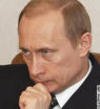
Russian president Vladimir Putin raised some eyebrows the other day when he called the collapse of the Soviet Union "the greatest geopolitical catastrophe of the last century." Earler Putin had angered former east-bloc countries by calling the Hitler-Stalin Pact "historically justified." Putin’s efforts to rewrite history are putting a damper on the festivities planned in Moscow next month to celebrate the end of "the Great Patriotic War." Anne Applebaum writes about this today in her WaPo column:
But if we are to avoid turning the anniversary of the end of
World War II into a celebration of the triumph of Stalinism, more
should be done. To begin with, Congress should vote on a resolution
proposed this month by Rep. John M. Shimkus (R-Ill.), which calls on
Russia to condemn the Nazi-Soviet pact as well as the illegal
annexation of the Baltic states. "The truth is a powerful weapon for
healing, forgiving and reconciliation," the resolution states, in a
burst of unusual congressional eloquence, "but its absence breeds
distrust, fear and hostility."
Bush, too, should
show that he understands what really happened in 1945. Every recent
U.S. president has visited Auschwitz, and many have visited
concentration camps in Germany, too. Perhaps it’s time for American
presidents to start a new tradition and pay their respects to the
victims of Stalin. This is made difficult by the dearth of monuments in
Moscow, but it isn’t impossible. The president could, for example, lay
a wreath at the stone that was brought from the Solovetsky Islands, the
Soviet Union’s first political prison camp, and placed just across from
the Lubyanka itself. Or he could visit one of the mass-execution sites
outside of town.
Of course these would be nothing
more than purely symbolic gestures. But a war anniversary is a purely
symbolic event. Each commemoration helps all of us remember what
happened and why it happened, and each commemoration helps us draw
relevant lessons for the future. To falsify the record — to
commemorate the triumph of totalitarianism rather than its defeat —
sends the wrong message to new and would-be democracies in Europe, the
former Soviet Union and the rest of the world.
Few writers know more about historical truth in Russia than Anne Applebaum. Her history of the gulag should be required reading for all students of 20th centruy history (preferably read together with Aleksandr I. Solzhenitsyn). Meanwhile, the people of Lithuania are resisting the Putinization of History: President Valdas Adamkus will refuse to participate in the festivities in Moscow on May 9. Alexander Budde has an excellent report on German Radio about the remaining bitterness of Lithuanians towards Russia. Don’t mention the word Liberation to them:
Okkupation, Deportation und Verhaftungen,
die entsetzliche Tragödie des Holocaust,Konzentrationslager, erzwungene
Emigration – das waren die Folgen zweier totalitärer Regime für die
litauische Nation. 350 000 Litauer wurden ermordet, verhaftet oder in
Straflager verschleppt. Und als der grausamste Krieg in der Geschichte
offiziell vorbei war, gingen die Verbrechen in Litauen weiter. Es gibt
keine einzige Familie, die nicht Verluste und Terror erlitten hat.Von ”Befreiung” könne keine Rede sein, so begründet der litauische
Präsident seine Weigerung, bei der Siegesfeier am 9. Mai in Moskau
dabei zu sein. Ein Affront gegen den russischen Gastgeber, zumal der
estnische Amtskollege Arnold Rüütel mit einer fast gleich lautenden
Erklärung für einen weiteren Paukenschlag in Richtung Russland sorgte.
Doch Valdas Adamkus steht zu seinem Wort:
As for the view of Vladimir Putin on the street, here is how one person interviewed responded.
Gar nichts halte ich von Putin! Von
Demokratie will der nichts wissen. Der will doch bloß dem Stalin ein
Denkmal setzen mit dieser Feier.
Is American history in danger of becoming Putinized? Sadly, yes.
