
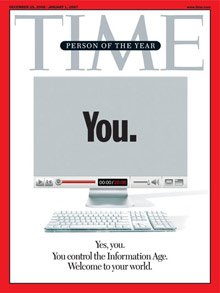
Now that Time Magazine has chosen the Web 2.0 phenonomen as Person of the Year, the concept has definitely jumped the shark.
"The tool that makes this possible is the World Wide Web. Not the Web that Tim Berners-Lee hacked together (15 years ago, according to Wikipedia) as a way for scientists to share research. It’s not even the overhyped dotcom Web of the late 1990s. The new Web is a very different thing. It’s a tool for bringing together the small contributions of millions of people and making them matter. Silicon Valley consultants call it Web 2.0, as if it were a new version of some old software. But it’s really a revolution."
As if to underscore how overheated Web 2.0 has become, the New York Times has a silly piece on its front page this morning about Silicon Valley venture capitalists conducting ad hoc market research with their teenaged kids:
These venture capital investors say there is good reason to ask young people to help them assess new technology: as the investors themselves are aging, the technology — including social networking Web sites and mobile gadgets — is designed for, used by and sometimes built by people half their age.
“Children are a secret weapon in my arsenal for making investment decisions,” said Heidi Roizen, a managing director at Mobius Venture Capital, a Silicon Valley firm.
Kids may point the way to some cutting-edge ideas, but what constitutes "coolness" is ephemeral; and teenagers are notoriously fickle. Look what is happening with MySpace – which was acquired by Rupert Murdoch’s News Corp. empire for $580 million. Some teens are no longer quite as enthralled with MySpace, now that it has become mainstream:
MySpace’s notoriety could be a turnoff for young people who are looking for an online community of their own, said Amanda Lenhart, a senior researcher for the Pew Internet and American Life Project. Lenhart has studied teens’ online behavior since the late 1990s. “Teens will go where their friends go,” she said. “They’re always looking for new places to gather. If those places become viewed as more regulated, they’ll move on.”
Which leads one to wonder whether News Corp. will ever see a return on its huge investement in the social networking site. Look, the demographic with the dollars to spend and which tends to exhibit more brand loyalty has always been the baby boomers; yet the Sand Hill VCs remain fixated on teenagers. I personally see more promise in baby-boomer oriented ventures, such as Monster.com founder Jeff Taylor’s new site Eons.com, which he started with $10 million of his own funds.
With the Time Magazine coverage, Web 2.0 has entered a bubble-phase which is likely to burst, leaving disappointed investors in its wake. These are the same investors who in the dotcom frenzy of the late 90s forgot some fundamental lessons in sustainable business models.
Anyone for Web 3.0?

0 comment
Everyone means nobody. Me means not you. Thank you.
Web 20.20