
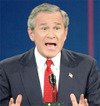
Senate Democrat Leader Harry Reid set off an interesting debate in the blogosphere when he said the following last week about President Bush:"I really do believe this man will go down as the worst president this country has ever had." Certainly I had to endorse Reid’s assessment as I watched President Bush’s miserable performance yesterday as he told an audience in Cleveland about the "wonderful progress" that was being made in Iraq. Harvard-trained blogger Matt Yglesias disagrees with Reid, and makes a half-hearted argument that Bush is “somewhat worse than, say, his father. But somewhat better than Ronald Reagan." A case could indeed be made that Reagan used racial politics to polarize the nation, and many of the problems facing the United States today have their roots in the Reagan era. But for sheer incompetence and radicalism, Bush will be seen as the worst president. Josh Marshall summarizes it best on his blog:
Reagan had the ability, simply, to change his mind. You might say it’s the ability to allow the facts to overcome your mind or as our secular saint, President Lincoln, put it, far more eloquently, the ability to ‘disenthrall ourselves.’
And that is an ability the current occupant of the White House entirely lacks — a fact which is on display now as he again crosses the country arguing that black is white and up is down.
President Bush represents something different from the normal sloshing back and forth between liberalism and conservatism. He’s a radical. He’s set on a destructive course, laced with corruption and fed by extremism. And he mistakenly believes that stubborness and ignorance constitute a virtue he calls ‘leadership’.
After his speech yesterday, President Bush took questions from the audience. The first question came from a woman who cited the book American Theocracy by the conservative author Kevin Phillips.
The book – which I haven’t read yet – deals with three risks that face America today: radical religion (which I have called Christo-Fascism), dependence on oil, and reliance on debt. A review of the book in the New York Times discusses Phillips’ analysis of the radical religious threat:
He [Phillips] points in particular to the Southern Baptist Convention, once a scorned seceding minority of the American Baptist Church but now so large that it dominates not just Baptism itself but American Protestantism generally. The Southern Baptist Convention does not speak with one voice, but almost all of its voices, Phillips argues, are to one degree or another highly conservative. On the far right is a still obscure but, Phillips says, rapidly growing group of "Christian Reconstructionists" who believe in a "Taliban-like" reversal of women’s rights, who describe the separation of church and state as a "myth" and who call openly for a theocratic government shaped by Christian doctrine. A much larger group of Protestants, perhaps as many as a third of the population, claims to believe in the supposed biblical prophecies of an imminent "rapture" — the return of Jesus to the world and the elevation of believers to heaven.
Prophetic Christians, Phillips writes, often shape their view of politics and the world around signs that charlatan biblical scholars have identified as predictors of the apocalypse — among them a war in Iraq, the Jewish settlement of the whole of biblical Israel, even the rise of terrorism. He convincingly demonstrates that the Bush administration has calculatedly reached out to such believers and encouraged them to see the president’s policies as a response to premillennialist thought. He also suggests that the president and other members of his administration may actually believe these things themselves, that religious belief is the basis of policy, not just a tactic for selling it to the public. Phillips’s evidence for this disturbing claim is significant, but not conclusive.
Phillips has some interesting comments about his book on the liberal group blog TPM Cafe. Here he talks about Bush’s base, which – despite the disasterous record – remains unshakeable:
The Republicans have profited from a weak opposition. Bluntly put, since the 1960s the Democrats have been the vehicle for the growth of secularism and irreligion among perhaps a third of the U.S. population. Strong churchgoers now vote Republican for president by roughly 3:1. As of 2005-2006, the new chance for the Democrats is to compete for the people in the middle – in particular, merely occasional religious attendees and moderates – who think that the liberals went too far in the 1960s and 1970s but that the Religious Right and the would-be theocrats are the danger now. That is certainly my anslysis, and it is developed at great length in American Theocracv.
Electorally, It’s useful to divide Bush’s supporters in two. On one side, the economic conservatives and centrist traditional GOPers; on the other, the true-believing religious electorate. He’s lost many of the middle-roaders with his Iraq, Katrina and Schiavo bungling. However, as long as he has most of his religious voters, it’ll be hard to push him below 35-40% job approval in the national polls.
Fear is likely to remain a Bush tactic. His people have tried to polarize voters into seeing a fight between good and evil, stoking fear and a sense of global chaos. The doomsday preachers are on the same side.
UPDATE: You can hear an interview with Kevin Phillips HERE.
Bush Christo-Fascism incompetence
