
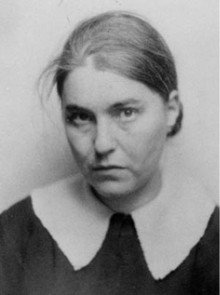
Die Toten bleiben jung (The Dead Stay Young) is the first novel in Seghers' Deutschlandromane trilogy. Earlier, I reviewed the second novel in the series – Die Entscheidung. Die Toten blieben jung is the first major German postwar socialist Zeitroman; most of it was completed while Seghers was living in exile in Mexico City, and she is able to avoid the Stalinist apologetics that mar DIe Entscheidung and Das Vertrauen – both of which were written in the SBZ (Soviet Occupied Zone). In Die Toten, Seghers returns to the great theme of her fiction: the rise of, and resistance to, National Socialism in Germany. The 600-page novel is a panaroma of Germany covering historical events from the Kapp Putsch to the collapse of the Wehrmacht on the Eastern Front in World War II.
The pivotal character of the novel. the young Sparticist Erwin, is killed off in the first couple of pages – "shot while fleeing" – and rest of the book follows the characters connected with the young revolutionary or involved in his murder. Seghers creates a sociological typology of the Weimar Republic: Marie, a destitute waitress and Erwin's lover, who, at the time of his murder is pregnant with their son Hans; Klemm, a German army officer who owns a chemical plant in Mainz, and his loyal chauffeur Becker; von Wenzlow, the brother-in-law of Klemm and the son of a Prussian officer; Lieven, a Baltic German whose land as been expropriated; and finally Nadler, a soldier and poor farmer. These are the central characters, and the novel attempts, in short chapters, to follow each of them in their separate milieus until they fatefully come together in the war towards the end of the novel. The constant shifting is often confusing to the reader so Seghers provides a helpful chart of the main figures at the beginning of the book.
What is interesting about Die Toten bleiben jung is that Seghers doesn't paint a simple black and white portrait of Weimar Germany. At least two thirds of the novel deals with the characters on the right of political spectrum who – for very different and nuanced motivations- make common cause with the Nazis. But these are not the caricatures of the "evil Nazis" one finds in the proletarian novels of Willi Bredel. Thus the Baltic German Lieven becomes a SS officer – not out of any political conviction or admiration of Hitler – but out of sheer boredom and the desire to reclaim his family's property in Riga. Von Wenzlow leads a battalion on the East Front not because he believes in the cause, but out of an exaggerated sense of duty and family tradition. The loyal chauffeur Becker loves his superior von Klemm as a brother because of their shared combat experience in the Great War and because he believes he is accepted by the wealthy von Klemm as an equal. When he realizes that the Volksgemeinschaft is nothing but an illusion and that he is viewed as little more than a servant, he kills himself and his boss by driving off a bridge.
It is interesting that for Seghers politics seems to be genetically predetermined. Thus Erwin's son Hans never learns who his real father is but intuitively resists the Hitler Youth and, in the end, is set to be executed for attempting to defect to the Soviets. Likewise, von Klemm's son Helmut is an enthusiastic young Nazi although he had little exposure to his dead father and his mother disapproves of his activities. In the end, the revolutionary genes will live on since, while Hans is executed like his father for "the cause", his girlfriend is pregnant with his child (presumably a son).
Seghers attempts to cover too much terrain in Die Toten bleiben jung but the novel is a fascinating exploration of world bent on self-destruction. There is a profound pessimism that pervades the book despite the rhetoric of revolution, a sadness which rings truer than the forced optimism of her later novels.

0 comment
That sounds fascinating and complex. But it’s frustrating in Hawaii, the difficulty of getting German books, and the expense.
I’m counting on Kindle to improve and offer more German titles.
That’s one of the downsides of living in Paradise, so far from good libraries or bookstores.
But FAZ is .75 an issue to download! And that’s nice. Keeps me in touch, some.