
Beginning in October 1940, Thomas Mann, living in Pacific Palisades, California, recorded a series of radio broadcasts for the German language propaganda effort of the BBC. The short addresses were usually broadcast each month until June of 1945, and Mann began each one with the exhortation Deutsche Hörer! The collaboration with the BBC was not without some friction: the British wanted 5 minute speeches, wHile Mann insisted on going 8 minutes, or even longer. The BBC was hoping for a more conciliatory tone in an effort to woo Germans, but Thomas Mann's addresses are dripping with sarcasm and seething with hatred of his Nazi adversaries.
It is not known how many Germans listened to Thomas Mann's radio broadcasts. Schwarzhören, or listening to foreign radio broadcasts, was strictly forbidden in Nazi Germany – punishable by death. Still, millions tuned into the German language programming of the BBC.
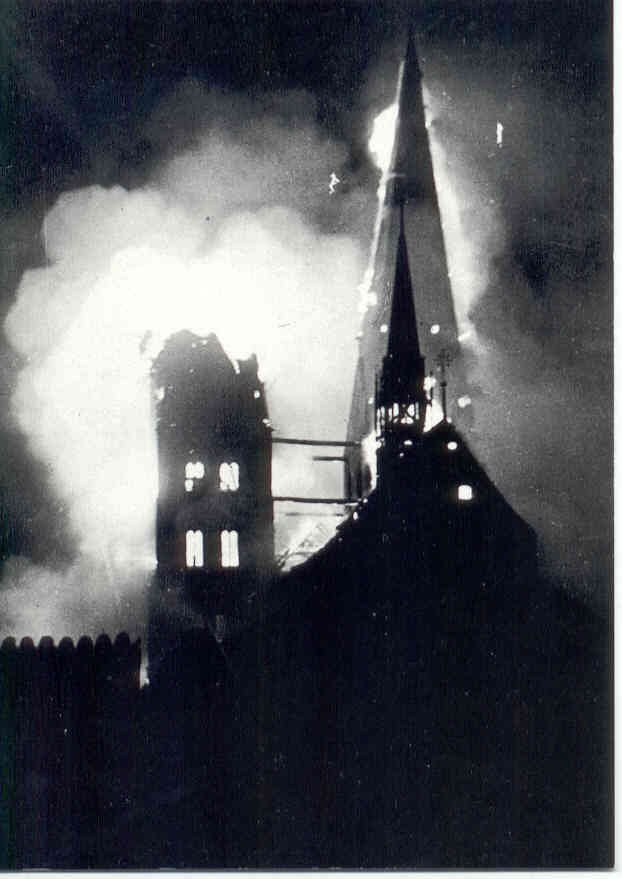
On the night of Palm Sunday 1942 the Royal Airforce firebombed the old city of Lübeck – a city with little strategic value. This was Mann's home town, and the Buddenbrooks House was completely destroyed, although, as Mann noted, the Nazis had renamed it as the Wullenweber House in an effort to erase the memory of Thomas Mann. A few days later, Mann speaks about the bombing of his beloved city in a BBC Broadcast (note: this is one of several Deutsche Hörer! broadcasts available on YouTube):
Mann starts off speaking about the bombing of Coventry a year earlier, as well as the Nazi aerial war in Spain and Poland and the the destruction of Rotterdam.
Partial Transcript:
Die Zeit kommt und ist schon da, wo Deutschland zu schluchzen hat auch über das, was es erleidet, und dieses Rührungsmotiv wird überhandnehmen in dem Maß, wie eine Welt, die von solcher Art Dienst an der Menschheit nichts hatte wissen wollen und nicht darauf vorbereitet war, in ihre Verteidigungsaufgabe hineinwächst und den Lehrling abgibt, der den Meister überflügelt.
Hat Deutschland geglaubt, es werde für die Untaten, die sein Vorsprung in der Barbarei ihm gestattete, niemals zu zahlen haben? Es hat kaum zu zahlen begonnen – über dem Kanal und in Rußland. Auch was die Royal Air Force in Köln, Düsseldorf, Essen, Hamburg und andern Städten bis heute zuwege gebracht hat, ist nur ein Anfang.
Hitler prahlt, sein Reich sei bereit zu einem zehn-, ja zwanzigjährigen Kriege. Ich nehme an, daß ihr Deutsche euch euer Teil dabei denkt – zum Beispiel, daß in Deutschland nach einem Bruchteil dieser Zeit kein Stein mehr auf dem andern wäre.
(Now the time nears and is already here, when Germany must sob about its own sufferings, ahd this cause for sobbing will increase while a world which did not want such service to humanity , and was not prepared for it, adapts itself to its task of defense and becomes the apprentice who surpasses the master. Did Germany believe that it would never have to pay for the misdeeds which its lead in barbarism enabled it to commit? It has barely begun to pay – over the Channel and in Russia. Also, what the Royal Air Force has accomplished so far in Cologne, DUesseldorf, Essen, Hamburg and other cities is only a beginning. Hitler is boasting that his Riech is ready for ten, even twenty years of war. I assume that you Germans have your own ideas about that – for example, that after a fraction of this time no stone will stand on top an another in Germany.)
(HT Rena Jacob)

0 comment
Mit Schriftstellern kann man über alles reden, aber nicht über fünf Minuten.
Maybe Mann should have had only 2 minutes. Maybe his words should have sounded more like a machine gun than like a typewriter. Imagine the situation: You were a German secretly listening to the BBC, and you expect something that is worth the risk. You want information you would not get otherwise, you probably don’t want to die for a ‘Sonntagsrede’.
Mann’s Deutsche Hörer! addresses were much more than Sonntagsreden. For Mann was an internationally famous German figure, a representative of German culture for the world, but also for many Germans. So his words were an important refutation of the Nazi propaganda that controlled every media outlet in Germany.
But still, it would be good to learn about how his talks were received within Germany at the time. I know there was a great deal of hostility towards Mann in the immediate postwar period.
“I know there was a great deal of hostility towards Mann in the immediate postwar period.”
Quelle surprise! 😀
Would you prefer that he had stayed in Germany and been murdered in a KZ just like another Nobel Prize winner – Carl von Ossietzky?
Had I lived in the 1940s, I most likely would. A man who enjoys the prospect of his homeland’s downfall would not have been missed.
There is no joy in Thomas Mann’s addresses. Only sorrow for his countrymen bent on total war and self-destruction.