
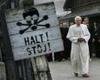
Pope Benedict XVI visited the site of the Auschwitz death camp yesterday and gave a short address (original German, English translation) which, in my opinion, struck the right notes. Benedict has come under some criticism for blaming the Holocaust in the speech on "a band of criminals" rather than on the German people as a whole, and also for not acknowledging his own background and imputed culpability as a German national. But he delivered the address in his native German – the only time he spoke German during his trip to Poland. And he noted the importance of the occasion as the first German pope ("a son of the German Volk") to visit Auschwitz:
Papst Johannes Paul II. stand hier als Sohn des polnischen Volkes. Ich stehe hier als Sohn des deutschen Volkes, und gerade deshalb muß ich, darf ich wie er sagen: Ich konnte unmöglich nicht hierherkommen. Ich mußte kommen. Es war und ist eine Pflicht der Wahrheit, dem Recht derer gegenüber, die gelitten haben, eine Pflicht vor Gott, als Nachfolger von Johannes Paul II. und als Kind des deutschen Volkes hier zu stehen – als Sohn des Volkes, über das eine Schar von Verbrechern mit lügnerischen Versprechungen, mit der Verheißung der Größe, des Wiedererstehens der Ehre der Nation und ihrer Bedeutung, mit der Verheißung des Wohlergehens und auch mit Terror und Einschüchterung Macht gewonnen hatte, so daß unser Volk zum Instrument ihrer Wut des Zerstörens und des Herrschens gebraucht und mißbraucht werden konnte. Ja, ich konnte unmöglich nicht hierherkommen.
Characteristically he presented a theological – as opposed to a personal, historical – interpretation of the Holocaust and the Nazi regime that was responsible for it. They were engaged in a war against Christianity, and by persecuting Jews were attempting to destroy the "taproot" of the Judeo-Christian tradition:
Deep down, those vicious criminals, by wiping out this people, wanted to kill the God who called Abraham, who spoke on Sinai and laid down principles to serve as a guide for mankind, principles that are eternally valid. If this people, by its very existence, was a witness to the God who spoke to humanity and took us to himself, then that God finally had to die and power had to belong to man alone – to those men, who thought that by force they had made themselves masters of the world. By destroying Israel, by the Shoah, they ultimately wanted to tear up the taproot of the Christian faith and to replace it with a faith of their own invention: faith in the rule of man, the rule of the powerful.
But Benedict's attempt to answer his own question – Why, Lord, did you remain silent? – is somehow unsatisfactory:
We cannot peer into God’s mysterious plan – we see only piecemeal, and we would be wrong to set ourselves up as judges of God and history. Then we would not be defending man, but only contributing to his downfall.
Perhaps there can be no satisfactory answer. But for those of us wrestling with faith, the existence of those crematoriums at Auschwitz remains a nearly insurmountable challenge.
Pope Benedict Benedikt papst holocaust

0 comment
“the existence of those crematoriums at Auschwitz remains a nearly insurmountable challenge”
What exactly is the problem? This is a frequently heard sentiment, and it implies that you expect God to prevent evil or at least to put an upper limit on the amount of evil men can do in a particular place and time. It also implies that you know what that limit should be.
What arrogant piffle! Apparently God isn’t good enough for you; He doesn’t meet your standards.
Your sentiment also implies that you expect God to protect you from all physical harm. Come on! Grow up! God may be your Father, but He isn’t your daddy. Believers are often taunted for clinging for comfort to a childish fantasy of a Great Big Daddy in the sky. It is unseemly then for unbelievers to base even a little of their rejection of God on the existence of “evil”.
Suppose there is no God, that the scientists are right and we are just the product of pointless random material processes. In that case, a person has no more “moral standing” than a rock. But without a God, “moral standing” and “evil” are meaningless expressions.
“The existence of those crematoriums at Auschwitz remains a nearly insurmountable challenge” . . . can you put that in a syllogism? Never mind Auschwitz. Simple thinking seems to be an insurmountable obstacle for you.